
Prices in AUD. Free Australian delivery for orders over $400. Free international delivery for orders over $800. Read full terms.
Showing 81–91 of 91 resultsSorted by latest
-
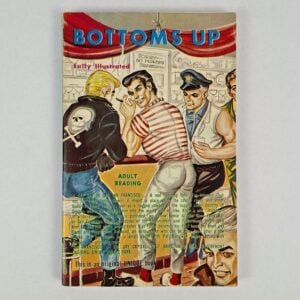
Bottoms Up
AU$400 Read MoreAdd to cartNed Winslow
: Unique Books, 1966.A gay bar in gay San Francisco. Cover illustration by Gene Bilbrew and 6 interior black and white illustrations by various artists. One of the many gay erotic pulp novels produced in the mid to late 20th century. These short sexually explicit stories, many of which were formulaic and published in easily recognisable series with graphically illustrated covers and titillating titles each targeting a specific sexual niche, demonstrate the breadth of sexual fantasy, occupation, desire, and deviance of the emerging homosexual culture.
-


The Boy Avengers
AU$200 Read MoreAdd to cartKarl Flinders
New York: The Traveller’s Companion, 1971.Gay pulp TC-516. One of the many gay erotic pulp novels produced in the mid to late 20th century. These short sexually explicit stories, many of which were formulaic and published in easily recognisable series with graphically illustrated covers and titillating titles each targeting a specific sexual niche, demonstrate the breadth of sexual fantasy, occupation, desire, and deviance of the emerging homosexual culture.
-


The Gas
AU$200 Read MoreAdd to cartCharles Platt
New York: Ophelia Press, 1970.Erotic science fiction pulp OPH-216. “Passion and violence are terrifyingly unleashed upon the South of England when a mysterious gas leaks from a biological warfare plant. Every unthinkable desire rises to the surface, both the ecstatic and the agonizing.” (from cover blurb)
-


The Young Married Lesbian
AU$100 Read MoreAdd to cartGene Wyman
New York: Star Distributors, 1975.One of the many lesbian pulp novels produced in the mid to late 20th century. Often formulaic and issued in easily recognisable series with suggestive covers and titillating titles, the genre was written largely by male authors under female pseudonyms for a male readership, though a smaller number of authors, some of them lesbian or bisexual women writing under similar pseudonyms, brought more narrative sincerity and psychological depth to the same commercial format. The genre as a whole ranges from outright formulaic titillation to more literary treatments of lesbian relationships within the constraints of the paperback original.
-

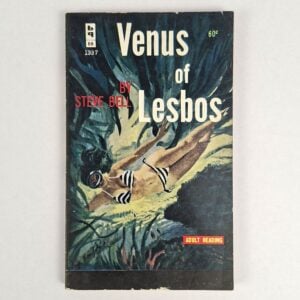
Venus of Lesbos
AU$100 Read MoreAdd to cartSteve Bell
[London]: Gadoline, 1975.Bedside Books BB1337, the English edition of the Newstand Library pulp. Cover illustration by Robert Bonfils. One of the many lesbian pulp novels produced in the mid to late 20th century. Often formulaic and issued in easily recognisable series with suggestive covers and titillating titles, the genre was written largely by male authors under female pseudonyms for a male readership, though a smaller number of authors, some of them lesbian or bisexual women writing under similar pseudonyms, brought more narrative sincerity and psychological depth to the same commercial format. The genre as a whole ranges from outright formulaic titillation to more literary treatments of lesbian relationships within the constraints of the paperback original.
-
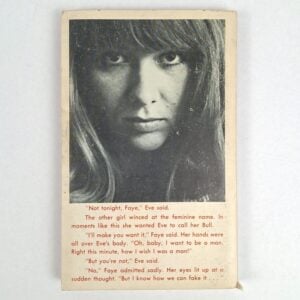
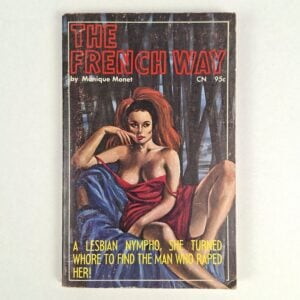
The French Way
AU$150 Read MoreAdd to cartMonique Monet
North Hollywood: All Star Books, 1965.Lesbian pulp AS 54. “A lesbian nympho, she turned whore to find the man who raped her!” One of the many lesbian pulp novels produced in the mid to late 20th century. Often formulaic and issued in easily recognisable series with suggestive covers and titillating titles, the genre was written largely by male authors under female pseudonyms for a male readership, though a smaller number of authors, some of them lesbian or bisexual women writing under similar pseudonyms, brought more narrative sincerity and psychological depth to the same commercial format. The genre as a whole ranges from outright formulaic titillation to more literary treatments of lesbian relationships within the constraints of the paperback original.
-
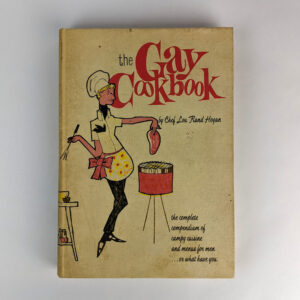
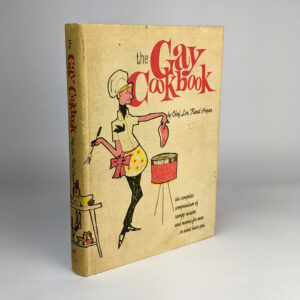
The Gay Cookbook
AU$300 Read MoreAdd to cartLou Rand Hogan; David Costain
Los Angeles: Sherbourne Press, 1965.First edition, first printing, of “the complete compendium of campy cuisine and menus for men…or what have you” by Chef Lou Rand Hogan. Campy cartoons by David Costain. The first cookbook marketed to the gay man. Hogan, after a failed attempt at a career in show business, learned the art of cooking fine cuisine working luxury cruises where he was part of a deliciously camp work culture, the humour of which is evident in his writing style. A good copy of this early example of positive gay culture in 20th century print media.
-

The Federal Liquor Service
AU$150 Read MoreAdd to cartTullie Wollaston
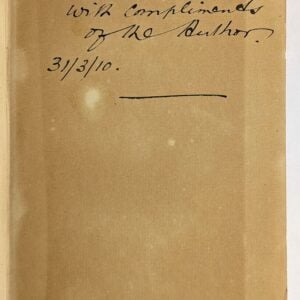
Melbourne: Thomas C. Lothian, 1910.Adelaide opal merchant Tullie Wollaston here turns to social reform amid the intense Federation-era debate over alcohol regulation, as the temperance movement pressed for change, proposing a Commonwealth monopoly over the liquor trade. He opens with a tale of a berry on a Pacific island, drawing the conclusion that Australians were “worse lunatics over the sale of ALCOHOL than the islanders over their berry.” Wollaston reviews and rejects the principal liquor-control systems then under discussion internationally, including prohibition, government monopoly schemes, the Public House Trust movement, and the Gothenburg system. Finding each inadequate (though sympathetic to prohibition, he acknowledges that its adoption in Australia would be “insuperably difficult at this late stage”), he advances his own solution: a “Federal Liquor Service” that would replace private licence holders with a centrally administered national authority. Presentation copy, inscribed by the author to the Reverend A. E. Gifford, dated 31/3/10.
-

Drug Addiction: A Process Statement
Read MoreThe Process Church of the Final Judgement
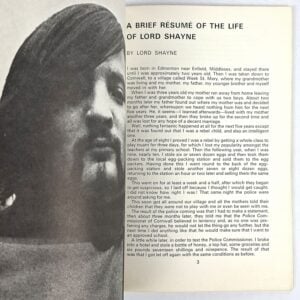
Printed in Canada by Graphic Centre: The Process Church of the Final Judgement, No date.A short biography of the junkie Lord Shayne together with short introductions by him to heroin, cocaine, methedrine, physeptone, morphine, drinamyl, dexedrine and benzedrine, phenobarbitone, and marijuana. This is followed by statements on addiction by The Process Church, a religious group active in the United Kingdom and North America in the 1960s and 1970s.
-


Le Diable Amoureux
AU$400 Read MoreAdd to cartJacques Cazotte; Paul-Emile Becat
Paris: La Tradition, 1936.The Devil in Love. Occult romance first published in 1772. This the first edition with erotic illustrations by Becat. One of 450 numbered copies on Arches vellum (of a total edition of 500).
-

A Dissertation on Milk
AU$1,000 Read MoreAdd to cartSamuel Ferris
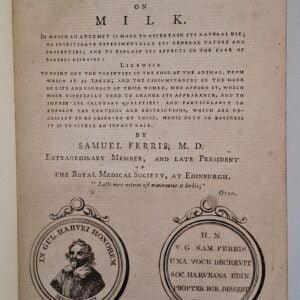
London: John Abraham, [1785].In which an attempt is made to ascertain its natural use; to investigate experimentally its general nature and properties; and to explain its effects in the cure of various diseases: Likewise to point out the varieties in the food of the animal, from which it is taken; and the circumstances in the mode of life and conduct of those women, who afford it, which more especially tend to change its appearance, and to impair its salutary qualities: and particularly to enforce the cautions and restrictions, which are necessary to be observed by those, whose duty or business it is to suckle an infant race. One of the more substantial English-language eighteenth-century monographs devoted wholly to milk, combining experimental chemistry with medical, moral, and social thought on infant feeding, motherhood, female bodies, and the transmission of health and character. Ferris undertakes comparative chemical experiments on six milks (ass, human, mare, cow, goat, and ewe) and uses the results to advance a sustained argument for maternal breastfeeding against both wet-nursing and the nursery customs of the day. He maintains that a mother’s own milk is the best possible nutriment and casts a woman’s refusal to nurse her child as ‘one of the worst species of inhumanity’. He approvingly cites the late Dr William Hunter (1718-1783), who believed cancers of the breast occurred disproportionately among women who declined to breastfeed, and condemns the common practice of withholding the breast during the first days after birth. Where maternal nursing proves impossible, Ferris subjects the wet nurse to detailed scrutiny. Her diet, habits, mode of life, and even emotional state are made objects of prescription, the infant being thought to absorb the consequences of her conduct through her milk. The nursing body is thus framed throughout as an object of medical and social management, ordered in the interests of the ‘infant race’. Presentation copy, inscribed by Ferris to The Revd. Mr Tonyn, likely the Revd Charles William Tonyn (1732-1805), Rector of Radnage, Buckinghamshire, a parish situated near Great Missenden, where Ferris settled in 1785.