
Prices in AUD. Free Australian delivery for orders over $400. Free international delivery for orders over $800. Read full terms.
Showing 21–40 of 78 resultsSorted by latest
-
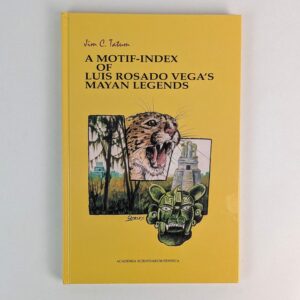
A Motif-Index of Luis Rosado Vega’s Mayan Legends
AU$40 Read MoreAdd to cartJim C. Tatum
Helskinki: Suomalainen Tiedeakatemia, 2000.The Mayan Culture, long recognised as among the most advanced indigenous groups of Latin America, possesses a rich heritage of mythology and traditions still very apparent in the Yacatan Peninsula at the closing of the twentieth century. Although Mayan legends have been studied and published as early as 1844, there exists no extensive motif-index dealing with the topic. This work attempts to help fill that need by indexing the works of Yacatecan writer Luis Rosaldo Vega. FF Communications No. 271 published by the Finnish Academy of Science and Letters.
-
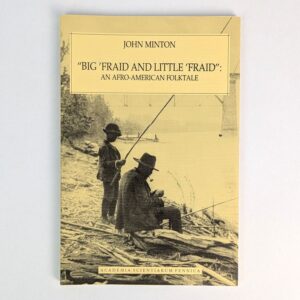
Big ‘Fraid and Little ‘Fraid: An Afro-American Folktale
AU$30 Read MoreAdd to cartJohn Minton
Helskinki: Suomalainen Tiedeakatemia, 1993.Though devoted specifically to the life history of the anecdote folklorists know as Tale Type 1676A/Motif K1682.1, Big ‘Fraid and Little ‘Fraid, this study more generally assesses the manner in which the circuitous epistemology of the tale indices compiled by, or in emulation of, Antti Aarne and Stith Thompson covertly subverted Richard Dorson’s controversial conclusions concerning the origins of Afro-American oral narratives, as well as the arguments of those who have challenged his position. FF Communications No. 253 published by the Finnish Academy of Science and Letters.
-
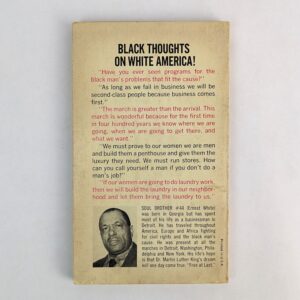
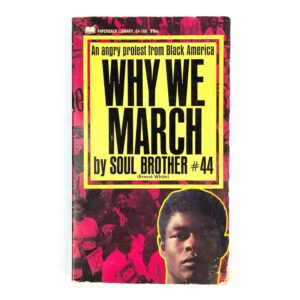
Why We March
AU$30 Read MoreAdd to cartSoul Brother #44 (Ernest White)
New York: Paperback Library, 1969.“An angry protest from Black America.”
-
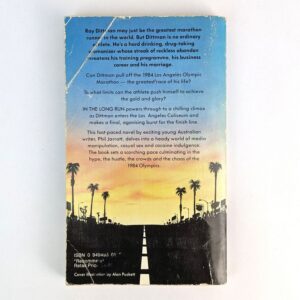
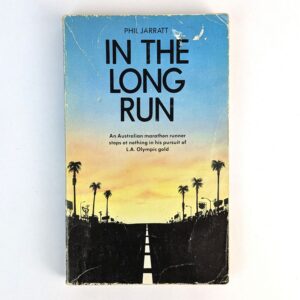
In The Long Run
AU$30 Read MoreAdd to cartPhil Jarratt
Sydney: James Fraser, 1984.“An Australian marathon runner stops at nothing in his pursuit of LA Olympic gold.”
-
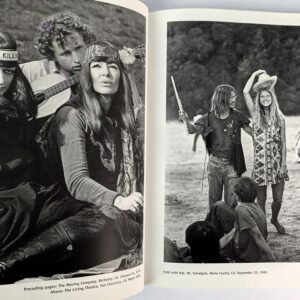
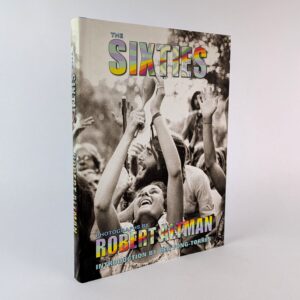
The Sixties
AU$50 Read MoreAdd to cartRobert Altman
Santa Monica: Santa Monica Press, 2007. -
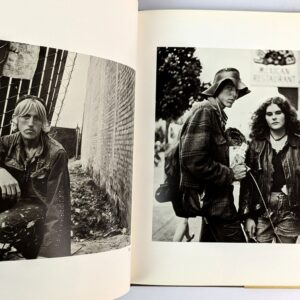
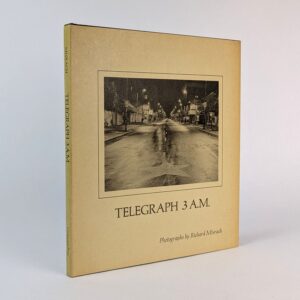
Telegraph 3 A.M.: The Street People of Telegraph Avenue, Berkeley, California
AU$400 Read MoreAdd to cartRichard Misrach
Berkeley: Cornucopia Press, 1974.First photobook of American photographer Richard Misrach (1949-), being street photography of the homeless residents of Telegraph Avenue in Berkeley, California.
-
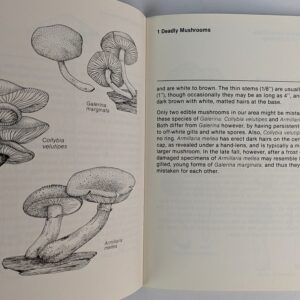
A Guide to the Poisonous Mushrooms in the Greater New York Area
AU$40 Read MoreAdd to cartThe New York Mycological Society
New York: The New York Mycological Society, 1976. -
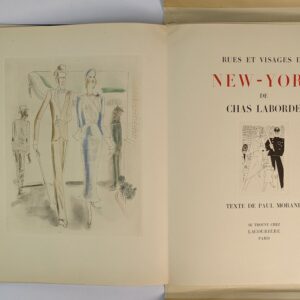
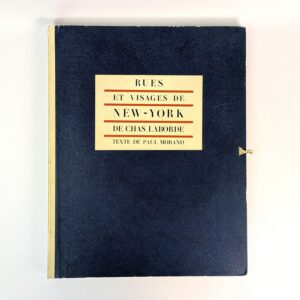
Rues et Visages de New-York
AU$2,200 Read MoreAdd to cartChas Laborde; Paul Morand
Paris: Lacouriere, 1950.Streets and Faces of New York. The final, and posthumous, of Charles Laborde’s series of works on famous world cities, having previously produced similar volumes on Paris (1926), London (1928), Berlin (1930), and Moscow (1935). The New York volume produced from sketchbooks he made on his trip in 1932, containing 15 accompanied by text by Paul Morand. One of 200 numbered copies on Arches from a total edition of 230.
-
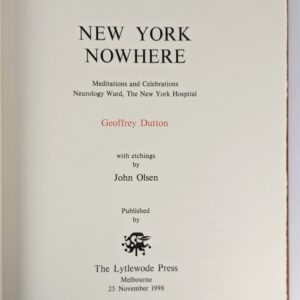
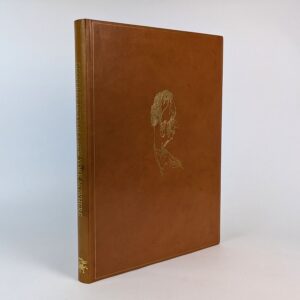
New York Nowhere: Meditations and Celebrations, Neurology Ward, The New York Hospital
AU$6,000 Read MoreAdd to cartGeoffrey Dutton; John Olsen
Melbourne: The Lytlewode Press, 1998.One of 30 deluxe copies from the total edition of 175 numbered copies signed by John Olsen and Robert Littlewood containing ten original signed etchings by John Olsen. The deluxe issue bound in brown kangaroo leather by Friedhelm Pohlmann also contains a tipped in sheet of original manuscript by the poet, ten original photographs of the artist and the poet signed by the publisher, five pieces of typescript correspondence hand signed by the publisher, 2 additional unsigned Olsen etchings, and an envelope containing a CD of Dutton reciting his poem. The recording of the CD made only weeks before Dutton’s death. New York Nowhere was Dutton’s last literary work, reflecting on the poet’s stroke and recovery in a New York hospital. Also included is the original prospectus and The Australian Magazine Dec 12-13, 1998 with the cover story on this work.
-
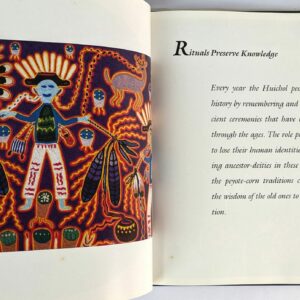

Huichol Indian Sacred Rituals
AU$120 Read MoreAdd to cartMariano Valadez; Susana Valadez
Oakland: Amber Lotus, 1992.Monograph of the peyote inspired paintings of the Huichol Indians. “The sacred ways of the Huichol Indians are vividly communicated in traditional art works called “yarn paintings”. Their symbols represent natural forces that are normally invisible, as well as shamanic ceremonies performed by the Huichol to contact, learn from, and work with these energies.” (from jacket blurb)
-

The Golden Age of Hispanic Silver, 1400-1665
AU$100 Read MoreAdd to cartCharles Oman
London: Her Majesty’s Stationery Office, 1968.In original Victoria and Albert Museum carton.
-

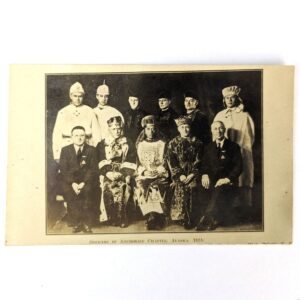
Officers of Anchorage Chapter, Alaska, 1924
AU$40 Read MoreAdd to cart[FREEMASONRY]
Adelaide: Kodak Austral, 1956.Real photo post card of the officers, manuscript note on verso of the positions from left to right.
-
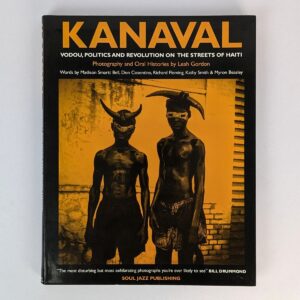
Kanaval: Vodou, Politics and Revolution on the Streets of Haiti
AU$100 Read MoreAdd to cartLeah Gordon
London: Soul Jazz Publishing, 2010.Photography and oral histories by Leah Gordon. Words by Madison Smartt Bell, Don Cosentino, Richard Fleming, Kathy Smith and Myron Beasley.
-
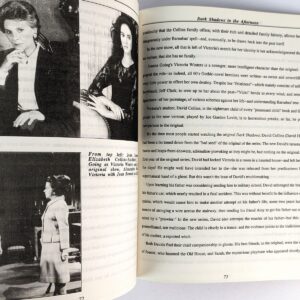
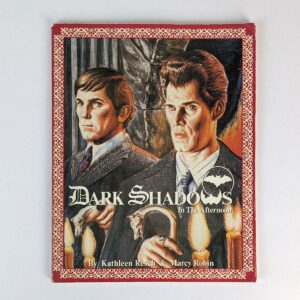
Dark Shadows in the Afternoon
AU$50 Read MoreAdd to cartKathleen Resch; Marcy Robin
New York: Image Publishing, 1991.A look at the American daytime TV horror soap opera, Dark Shadows. The original series ran for 1,225 episodes between 1966 and 1977.
-
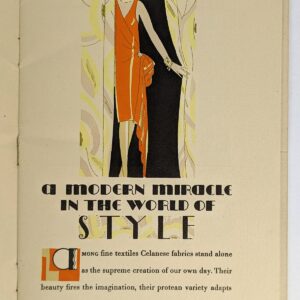
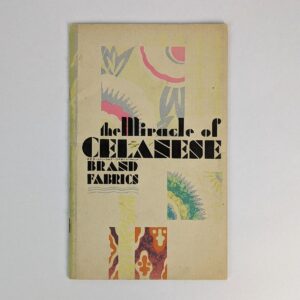
The Miracle of Celanese Brand Fabrics
AU$800 Read MoreAdd to cartCelanese Corporation of America
New York: Celanese Corporation of America, 1928.Early promotional booklet for Celanese, a cellulose acetate “artificial silk” fabric, produced by the Celanese Corporation of America. The firm, a Fortune 500 company still operating today as Celanese, the name being a portmanteaux of cellulose and ease, promoting the new product as easy to clean and care for. The booklet is illustrated throughout by Robert L. Leonard (1879-1958), a pioneering figure of American decorative arts, design, and illustration. Having studied and worked as an illustrator in Munich, Berlin, and Paris before migrating to the United States in 1923, he brought with him a modernist style which is on full show in the colourful art deco illustrations. Leonard was a founding member of the American Union of Decorative Artists and Designers and edited the first Annual of American Design in 1931. A rare treat of 1920s fashion and illustration, with only 1 copy recorded in OCLC, at The Metropolitan Museum of Art Library.
-
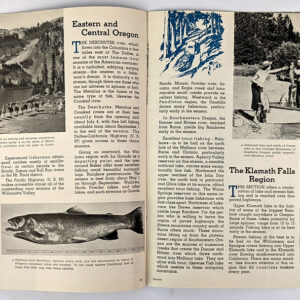

Fish Oregon Waters, Drive Oregon Highways
AU$60 Read MoreAdd to cartTravel and Information Department of the Oregon State Highway Commission
Salem: Travel and Information Department of the Oregon State Highway Commission, No date.1930s fishing travel guide to Oregon.
-
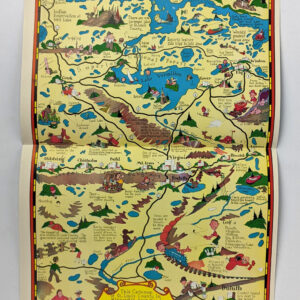
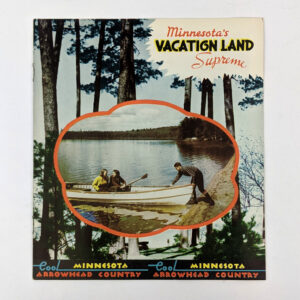
Minnesota’s Vacation Land Supreme
AU$80 Read MoreAdd to cartSt. Louis County Club
Gilbert: St. Louis County Club, No date.Circa 1940 brochure advertising activities, sights, and accommodation in St. Louis County. Colour map centrefold by Frank Antoncich in the cartoon map style of Ruth Taylor, St. Louis County, Minnesota.
-

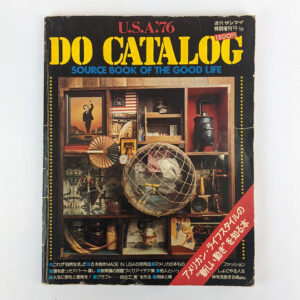
Do Catalog: Source Book of the Good Life (U.S.A. ’76)
AU$150 Read MoreAdd to cartMitsuo Kamiya
[Tokyo]: Sankei Shimbun Publishing Bureau, 1975.Japanese American lifestyle fetish catalogue copiously illustrated throughout with interior design, self sustainable living, crafts, and more. An addition to the library of Japanese American lifestyle fetish catalogs, a contribution to the mid 20th century development of the Japanese fascination with the American way of fashion, design, culture, and capitalism.
-
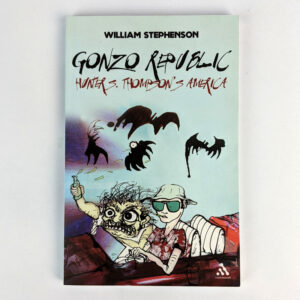
Gonzo Republic: Hunter S. Thompson’s America
AU$40 Read MoreAdd to cartWilliam Stephenson
London and New York: Continuum, 2012. -
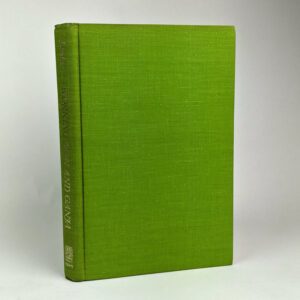
Working Men and Ganja: Marihuana Use in Rural Jamaica
AU$150 Read MoreAdd to cartMelanie Creagan Dreher
Philadelphia: Institute for the Study of Human Issues, 1982.A study on the commerce and use of ganja (marijuana) in three rural labour farmer villages in Jamaica. The study highlights a debate on ganja between socioeconomic divisions; the upper and middle class condemn it, while the labouring class claim it is beneficial for well being and even enhancing productivity.