
Prices in AUD. Free Australian delivery for orders over $400. Free international delivery for orders over $800. Read full terms.
Showing 101–200 of 201 resultsSorted by latest
-
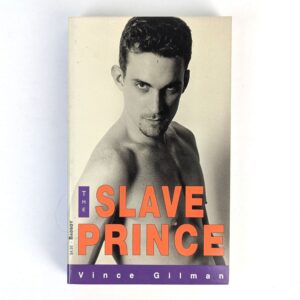
The Slave Prince
AU$40 Read MoreAdd to cartVince Gilman
New York: Badboy, 1994.One of the many gay erotic pulp novels produced in the mid to late 20th century. These short sexually explicit stories, many of which were formulaic and published in easily recognisable series with graphically illustrated covers and titillating titles each targeting a specific sexual niche, demonstrate the breadth of sexual fantasy, occupation, desire, and deviance of the emerging homosexual culture.
-
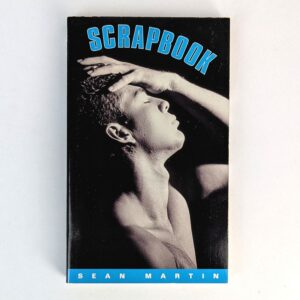
Scrapbook
AU$40 Read MoreAdd to cartSean Martin
New York: Badboy, 1994.Gay pulp short story collection.
-
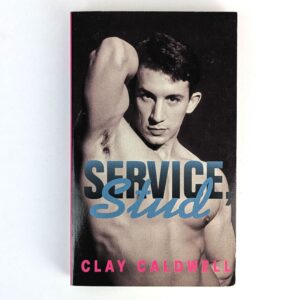
Service, Stud
AU$40 Read MoreAdd to cartClay Caldwell
New York: Badboy, 1995.One of the many gay erotic pulp novels produced in the mid to late 20th century. These short sexually explicit stories, many of which were formulaic and published in easily recognisable series with graphically illustrated covers and titillating titles each targeting a specific sexual niche, demonstrate the breadth of sexual fantasy, occupation, desire, and deviance of the emerging homosexual culture.
-
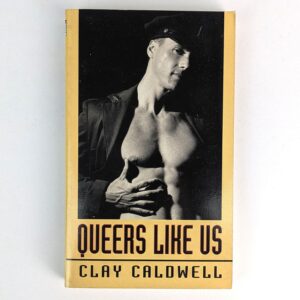
Queers Like Us
AU$40 Read MoreAdd to cartClay Caldwell
New York: Badboy, 1995.One of the many gay erotic pulp novels produced in the mid to late 20th century. These short sexually explicit stories, many of which were formulaic and published in easily recognisable series with graphically illustrated covers and titillating titles each targeting a specific sexual niche, demonstrate the breadth of sexual fantasy, occupation, desire, and deviance of the emerging homosexual culture.
-
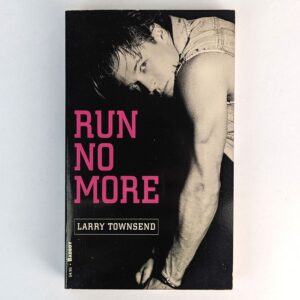
Run No More
AU$40 Read MoreAdd to cartLarry Townsend
New York: Badboy, 1993.One of the many gay erotic pulp novels produced in the mid to late 20th century. These short sexually explicit stories, many of which were formulaic and published in easily recognisable series with graphically illustrated covers and titillating titles each targeting a specific sexual niche, demonstrate the breadth of sexual fantasy, occupation, desire, and deviance of the emerging homosexual culture.
-

Mind Master
AU$40 Read MoreAdd to cartLarry Townsend
New York: Badboy, 1994.One of the many gay erotic pulp novels produced in the mid to late 20th century. These short sexually explicit stories, many of which were formulaic and published in easily recognisable series with graphically illustrated covers and titillating titles each targeting a specific sexual niche, demonstrate the breadth of sexual fantasy, occupation, desire, and deviance of the emerging homosexual culture.
-
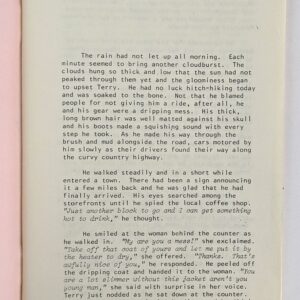
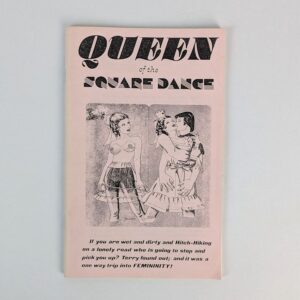
Queen of the Square Dance
AU$50 Read MoreAdd to cartAnonymous
: No publisher, No date.Reprint of an anonymous femdom forced feminisation crossdressing fiction. “If you are wet and dirty and Hitch-Hiking on a lonely road who is going to stop and pickup you up? Terry found out; and it was a one way trip to FEMININITY!” Cover illustration by Erica, dated 1977.
-
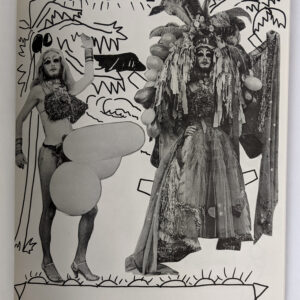
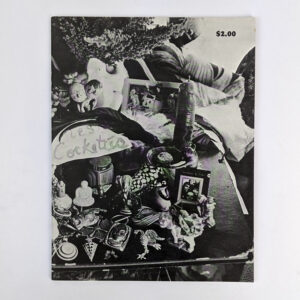
The Official Cockettes T.M. Paper Doll Book
AU$180 Read MoreAdd to cartJohn Flowers; Clay Geerdes
San Francisco: Last Gasp, 1971.Paper dolls of the acid drag hippie theatre troupe, Cockettes, all dressed in their finest drag for their New York City trip.
-

The Archaeology of Eros
AU$40 Read MoreAdd to cartJorge Socarras; Mel Odom
San Francisco: Dark Entries Editions, 2023.“Homoerotic poetry and art appear throughout the worlds civilizations for millennia. The Archaeology of Eros, the first collection of poems from cult music figure Jorge Socarras, taps into that continuum through the collaboration of acclaimed artist Mel Odom. Socarras’ intimate love poems and Odom’s evocative drawings are beautifully juxtaposed in this elegantly designed book. Straddling the sensual and the archetypal, the contemporary and the classical, poetry and art join forces in exploring the mystery and wonder of Eros, affirming that same-sex desire has lived before even as it flourishes now. Born to Cuban parents in New York City, Jorge Socarras (born 1952) is known for his 1970s collaboration with pioneering synthesizer musician Patrick Cowley as the duo Catholic, as singer-frontman of the 1980s avant-rock group Indoor Life and as half of the ongoing musical duo Fanatico X. He was also cofounder of the Silence=Death Collective, the AIDS activist group that in 1987 created the eponymous poster design and slogan. The award-winning art of Mel Odom (born 1950) has graced numerous book covers and magazines since the 1970s, has been the subject of two books, and has been exhibited in galleries and art institutions, including in collaboration with gay literary icon Edmund White.” (publisher’s blurb)
-
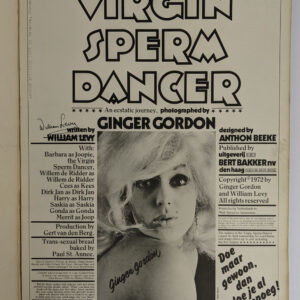
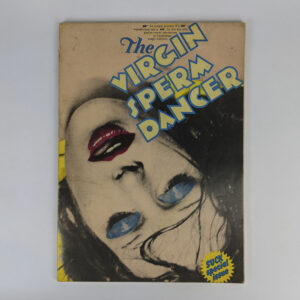
The Virgin Sperm Dancer
AU$600 Read MoreAdd to cartWilliam Levy; Ginger Gordon
The Hague: Uitgeverij Bert Bakker, 1978.An ecstatic journey of a boy transformed into a girl for one day only, and her erotic adventures in Amsterdam, magic centrum. A classic publication from the age of sexual liberation, The virgin sperm dancer is an early photobook which illustrates the story of Joop, a young Dutch man who experiences a day transformed as Joopie, a sexually awakened woman. Published as a Suck Special Issue of the Amsterdam-based pornography magazine Suck, The virgin sperm dancer clearly aims to titillate with its uncensored graphic photographs of the escapades in this fantasy. However through the lengthy narrative and exploration of the versatility of sexual experience, Sperm Dancer finds itself as a prototype for later works that explore sexual freedom and concepts of gender. Through depictions of free love in Amsterdam in the 70s with a focus on transsexuality, bisexuality, transvestism, and homosexuality, Sperm dancer avoids gender paradigms of masculinity and power, and includes women’s sexual empowerment and orgasm as a focus of the work. Unusually for a sex magazine, this standalone publication does not appear to pitch its eroticism to a particular sexuality but rather embraces the versatility of sexual experience as being its greatest appeal. The virgin sperm dancer was immediately influential and homaged on the cover of the September 1972 issue of London Oz. A second edition was published in 1978. Suck is touted as the first European sex newspaper and was launched in London in 1969 before moving to Amsterdam to avoid England’s anti-obscenity laws. Written by William Levy. Photographs by Ginger Gordon. This second printing copy signed by William Levy on the title page and inscribed by him to the wrappers verso, For Marta Norman – I became you – Bill 25 IX 78, and with the promotional flyer reproducing the title page laid in.
-
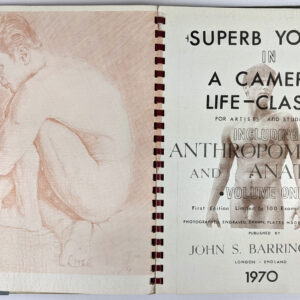
Superb Youth in a Camera Life-Class, For Artists and Students including Anthropometry and Anatomy (2 Volumes)
AU$2,500 Read MoreAdd to cartJohn S. Barrington
London: John S. Barrington, 1970.John S. Barrington (1920-1991) was a prolific 20th century British physique photographer. Receiving a formal art training in Paris, he was also a visual artist and sculptor, and earlier in his career worked in theatre design. Barrington began picking up and photographing men at the pool, eventually going on to establish one of the most prolific physique studios of the 20th century, during which time he probably published and distributed more full male nudes than any of his contemporaries up until the changing censorship laws in the latter part of the century. Superb Youth in a Camera Life-Class is one of his scarcest works, unrecorded in public collections, and with a stated limited edition of 100 copies (though this could be Barrington’s marketing at work). It combines his photography and visual art with detailed instruction in the art of the measurements and proportions of the male body, and features numerous photographs and drawings of many of his favourite models, who were also his lovers or unrequited lusts. A prospectus at the end of volume two alludes to a third and fourth volume to be published and available only to subscribers of the first two volumes, though no record can be found of them ever having been published.
-
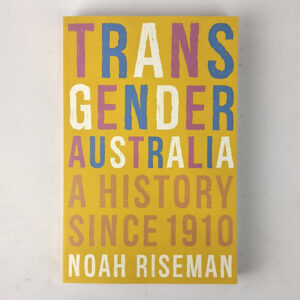
Transgender Australia: A History Since 1910
AU$40 Read MoreAdd to cartNoah Riseman
Melbourne: Melbourne University Press, 2023.“The first book on Australian trans history exploring the lives and impacts of trans and gender-diverse Australians. Trans and gender diverse people have always been present in Australian life, whether they’ve lived quiet lives in the country, performed in cabaret shows, worked on the streets or run for parliament. But over the last century there have been remarkable changes in how they have identified and expressed themselves. Transgender Australia is the first book to chart the changing social, medical, legal and lived experiences of trans and gender diverse people in Australia since 1910. Drawing on over a hundred oral history interviews and previously unexamined documents and media reports, it highlights how trans people have tried to live authentically while navigating a society that often treated them like outcasts.” (publisher’s blurb)
-

Who Does That Bitch Think She Is? Doris Fish and the Rise of Drag
AU$35 Read MoreAdd to cartCraig Seligman
Sydney: Hachette, 2023.“An exciting new history of drag told through the life of the remarkable, flawed, and singular Australian-born Doris Fish. In the 1970s, gay men and lesbians were openly despised and drag queens scared the public. Yet that was the era when Doris Fish (born Philip Mills in 1952) painted and padded his way to stardom. He was a leader of the generation that prepared the world not just for drag queens on TV but for a society that welcomes and even celebrates queer people. How did we get from there to here? In Who Does That Bitch Think She Is? Craig Seligman looks at Doris’s short but overstuffed life as a way to provide some answers. There were effectively three Dorises – the quiet visual artist, the glorious drag queen, and the hunky male prostitute who supported the other two. He started performing in Sydney in 1972 as a member of Sylvia and the Synthetics, a psycho troupe that represented the first anarchic flowering of queer creative energy in the post-Stonewall era. After moving to San Francisco in the mid-70s, he became the driving force behind years of sidesplitting drag shows that were loved as much as you can love throwaway trash – which is what everybody thought they were. No one, Doris included, perceived them as political theater, when in fact they were accomplishing satire’s deepest dream: not just to rail against society, but to change it. Seligman recounts this dynamic period in queer history – from Stonewall to AIDS – giving insight into how our ideas about gender have broadened to make drag the phenomenon we know it as today. In a book filled with interviews and letters about a life that ricocheted between hilarity and tragedy, he revisits the places and people Doris knew in order to shed light on the multi-hued era that his remarkable life encapsulated.” (publisher’s blurb)
-

The Myth of the Wrong Body
AU$25 Read MoreAdd to cartMiquel Misse
Cambridge: Polity, 2022.“The most popular narrative about transsexuality suggests that some people are born in the wrong body — that their bodies do not correspond to their inner experience and that their bodies should therefore be transformed. But in the view of the sociologist and trans activist Miguel Misse, this narrative is a harmful myth. It is rooted in a medical paradigm that typically leads to medical intervention to the use of hormones and surgical operations. By proposing a particular solution (modifying ones body), doctors and psychiatrists make it difficult for trans people to overcome malaise about their body in other ways and prevent them from recognizing the burden of social norms. Drawing on his own personal experience, Misse makes the case for a different way of thinking about trans embodiment which focuses on gender identity. The trajectory that leads people to become trans is shaped by the rigidity of gender norms, where the only two models available to individuals are the masculine man and the feminine woman. But these are not the only possible choices, and by critically interrogating the rigidity of gender norms, Misse opens up a different way of thinking about being trans, beyond the essentialism of the medical paradigm.” (publisher’s blurb) Translated from Spanish by Frances Riddle.
-
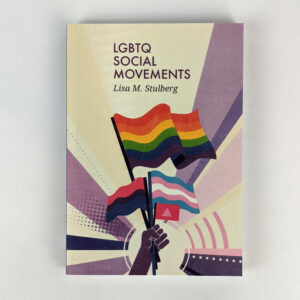
LGBTQ Social Movements
AU$35 Read MoreAdd to cartLisa M. Stulberg
Cambridge: Polity, 2018.“In recent years, there has been substantial progress on lesbian, gay, bisexual, transgender, and queer (LGBTQ) civil rights in the United States. We are now, though, in a time of incredible political uncertainty for queer people. LGBTQ Social Movements provides an accessible introduction to mainstream LGBTQ movements in the US, illustrating the many forms that LGBTQ activism has taken since the mid-twentieth century. Covering a range of topics, including the Stonewall uprising and gay liberation, AIDS politics, queer activism, marriage equality fights, youth action, and bisexual and transgender justice, Lisa M. Stulberg explores how marginalized people and communities have used a wide range of political and cultural tools to demand and create change. The five key themes that guide the book are assimilationism and liberationism as complex strategies for equality, the limits and possibilities of legal change, the role of art and popular culture in social change, the interconnectedness of social movements, and the role of privilege in movement organizing. This book is an important tool for understanding current LGBTQ politics and will be essential reading for students and scholars of sexuality, LGBTQ studies, and social movements, as well as anyone new to thinking about these issues. (publisher’s blurb)
-
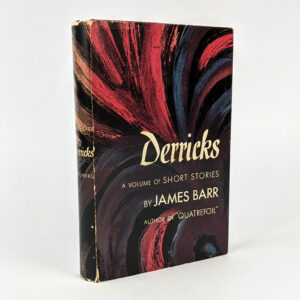
Derricks
AU$200 Read MoreAdd to cartJames Barr
New York: Greenburg, 1951.A collection of short stories. The second published work by of one of the first modern authors to portray homosexual characters positively. Written by James Fugate, under the pseudonym James Barr. YOUNG 185*.
-
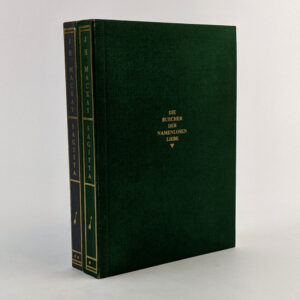
Die Buecher Der Namenlosen Liebe (2 Volumes)
AU$100 Read MoreAdd to cartJohn Henry Mackay [Sagitta]
Berlin: Verlag Rosa Winkel, 1979.The Books of Nameless Love. Seven volumes were originally published between 1906-1926 under the pseudonym Sagitta. Writer, anarchist, and advocate Mackay traces early developments of the homosexual emancipation movement in Germany.
-
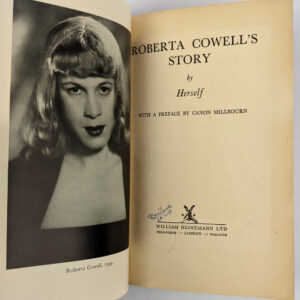
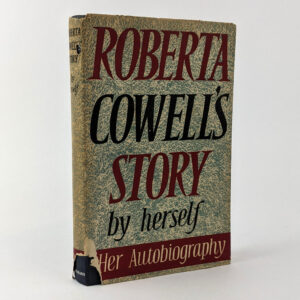
Roberta Cowell’s Story by Herself
AU$1,000 Read MoreAdd to cartRoberta Cowell
London: William Heinemann, 1954.Scarce autobiography of British race car driver, WWII fighter pilot, and first known British trans woman to undergo gender-affirming surgery in 1948 after Michael Dillon (British physician and the first trans man to undergo FtM surgery) performed an inguinal orchiectomy (removal of the testicles) on Cowell.
-
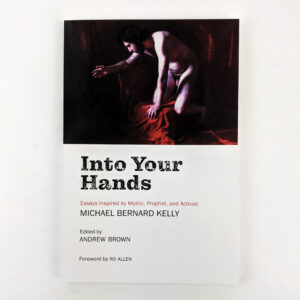
Into Your Hands: Essays Inspired by Mystic, Prophet, and Activist Michael Bernard Kelly
AU$30 Read MoreAdd to cartAndrew Brown
Melbourne: Clouds of Magellan Press, 2022.Academic and personal tributes to the life and work of leading Australian gay activist and religious commentator Michael Bernard Kelly.
-

Queering Psychedelics: From Oppression to Liberation in Psychedelic Medicine
AU$35 Read MoreAdd to cartAlex Belser; Clancy Cavnar; Beatriz C. Labate
Santa Fe & London: Synergetic Press, 2022.“As psychedelic-assisted therapy gains traction in popular culture and through policy reforms, Queering Psychedelics: From Oppression to Liberation in Psychedelic Medicine aims to foster accessibility and diversity in psychedelic science, practice, and discourse… Queering Psychedelics integrates indigenous outlooks on psychedelics, gender roles, and identity while aligning them with those of other marginalized groups: women, people of color, the disabled, the impoverished. This book interrogates the continuing radical potential of queer psychedelia in today’s era of assimilation, paving the way for an inclusive and intersectional world.” (publisher’s blurb)
-
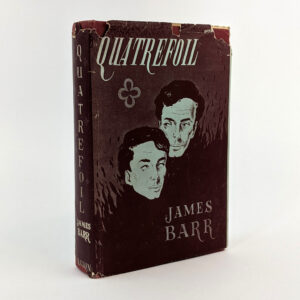
Quatrefoil
AU$200 Read MoreAdd to cartJames Barr
London: Vision Press, 1953.First UK edition of one of the first modern books to portray homosexual characters positively written by James Fugate, under the pseudonym James Barr.
-
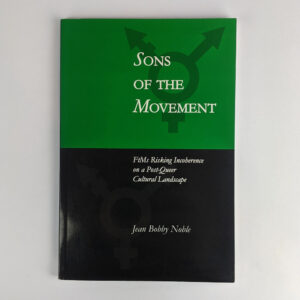
Sons of the Movement: FtMs Risking Incoherence on a Post-Queer Cultural Landscape
AU$55 Read MoreAdd to cartJean Bobby Noble
Toronto: Women’s Press, 2006.“Documents the female-to-male (FtM) transition process from an insider’s point of view, and details the limitations of both surgical procedures and pronouns. J. Bobby Noble challenges both the expectations of masculinity and white masculinity. As a result, this text is equally invested in creating both gender trouble and race trouble, calling for a new provocative analysis of the field of gender studies.” (publisher’s blurb)
-

Bad Habits
AU$20 Read MoreAdd to cartLindsay Welsh
New York: Rosebud, 1998. -
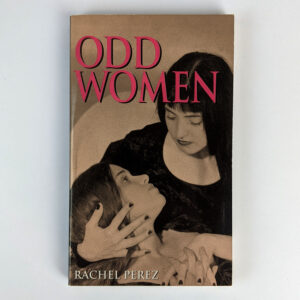
Odd Women
AU$30 Read MoreAdd to cartRachel Perez
New York: Rosebud, 1997. -
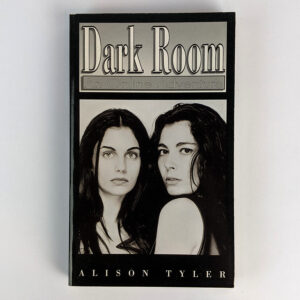
Dark Room: An Online Adventure
AU$30 Read MoreAdd to cartAlison Tyler
New York: Rosebud, 1996. -
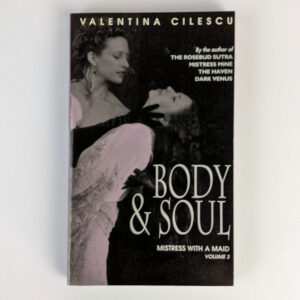
Body and Soul: Mistress with a Maid, Volume 3
AU$30 Read MoreAdd to cartValentina Cilescu
New York: Rosebud, 1993. -
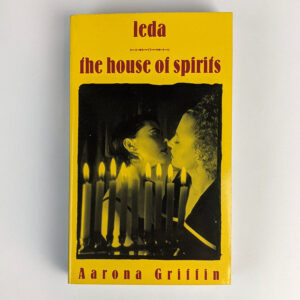
Leda and the House of Spirits
AU$30 Read MoreAdd to cartAarona Griffin
New York: Rosebud, 1997. -
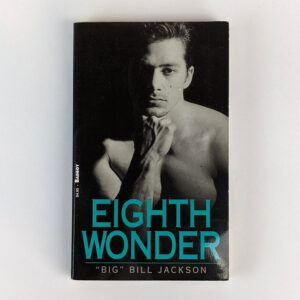
Eighth Wonder
AU$30 Read MoreAdd to cartBill Jackson
New York: Badboy, 1994. -
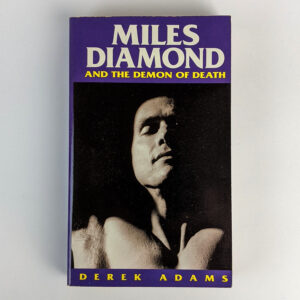
Miles Diamond and the Demon of Death (The Adventures of Miles Diamond II)
AU$40 Read MoreAdd to cartDerek Adams
New York: Badboy, 1995. -
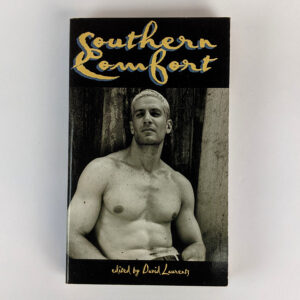
Southern Comfort
AU$50 Read MoreAdd to cartDavid Laurents
New York: Badboy, 1996. -

Twilight Women Around the World
AU$30 Read MoreAdd to cartR. Leighton Hasselrodt
London: Luxor Press, 1969.Sexploitation pulp sensational sexological study of lesbianism.
-
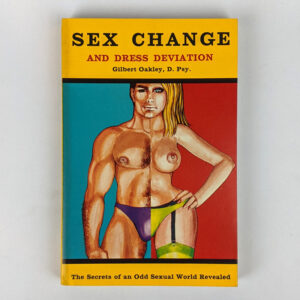
Sex Change and Dress Deviation
AU$40 Read MoreAdd to cartGilbert Oakley
London: Morntide, 1970.A psychological study of transvestites and transsexuals.
-
TV Tricks and other poems
AU$40 Read MoreAdd to cartIan MacNeill
Sydney: BlackWattle Press, 1989. -
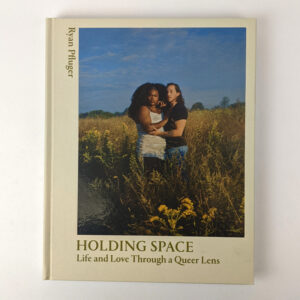
Holding Space: Life and Love Through a Queer Lens
AU$60 Read MoreAdd to cartRyan Pfluger
New York: Princeton Architectural Press, 2022.“Throughout 2020 and 2021, artist, advocate and photographer Ryan Pfluger set out to capture intimate images of queer, interracial couples, along with personal insight into their relationships in todays world. Featured together for the first time in this book, this unique collection of modern love in its many forms across the spectrum of race, sexuality, and gender identity and gives space to these couples to share short, revealing stories about their relationships. The photos in this collection, and the people in them, can be startling in their openness, playful in their poses, and tender to their core. Pfluger has captured the magic, honesty, and beauty of love in todays queer culture.” (publisher’s blurb)
-
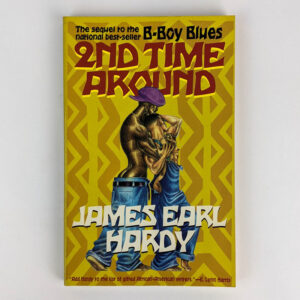
2nd Time Around
AU$40 Read MoreAdd to cartJames Earl Hardy
Los Angeles: Alyson, 1996.First printing of the second book in the B-Boy Blues series.
-
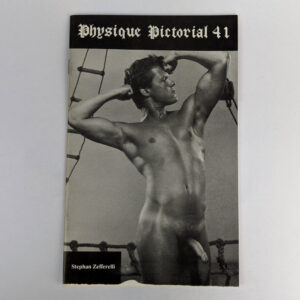
Physique Pictorial Volume 41, September 1990
AU$30 Read MoreAdd to cartBob Mizer
Los Angeles: Athletic Model Guild, 1990.The only 1990s issue, and the final issue in the original series of the most popular of beefcake magazines, Physique Pictorial, produced by Bob Mizer’s AMG (a relaunch of the series published from 2017 by the Bob Mizer Foundation). Early issues feature scantily clad athletic men in fitness poses together with homoerotic artwork by Tom of Finland, Harry Bush, George Quaintance, and others. If you can stayed focused the text provides insight into gay culture and rights at the time, as well as details on the models and artwork. Into the late 1960s and 1970s as the laws around censorship change, the beefcake physique magazine became more naked and blatantly homoerotic.
-
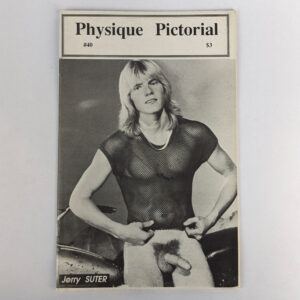
Physique Pictorial Volume 40, June 1987
AU$30 Read MoreAdd to cartBob Mizer
Los Angeles: Athletic Model Guild, 1987.Single 1980s, and the penultimate issue in the original series of the most popular of beefcake magazines, Physique Pictorial, produced by Bob Mizer’s AMG (a relaunch of the series published from 2017 by the Bob Mizer Foundation). Early issues feature scantily clad athletic men in fitness poses together with homoerotic artwork by Tom of Finland, Harry Bush, George Quaintance, and others. If you can stayed focused the text provides insight into gay culture and rights at the time, as well as details on the models and artwork. Into the late 1960s and 1970s as the laws around censorship change, the beefcake physique magazine became more naked and blatantly homoerotic.
-
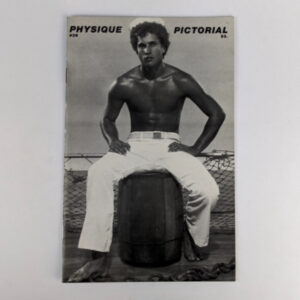
Physique Pictorial Volume 39, January 1986
AU$30 Read MoreAdd to cartBob Mizer
Los Angeles: Athletic Model Guild, 1986.Single 1980s issue of the most popular of beefcake magazines, Physique Pictorial, produced by Bob Mizer’s AMG. Early issues feature scantily clad athletic men in fitness poses together with homoerotic artwork by Tom of Finland, Harry Bush, George Quaintance, and others. If you can stayed focused the text provides insight into gay culture and rights at the time, as well as details on the models and artwork. Into the late 1960s and 1970s as the laws around censorship change, the beefcake physique magazine became more naked and blatantly homoerotic.
-
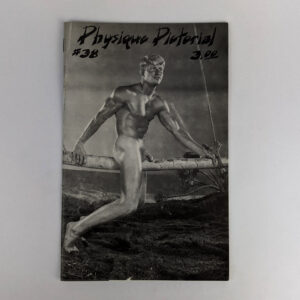
Physique Pictorial Volume 38, November 1984
AU$30 Read MoreAdd to cartBob Mizer
Los Angeles: Athletic Model Guild, 1984.Single 1980s issue of the most popular of beefcake magazines, Physique Pictorial, produced by Bob Mizer’s AMG. Early issues feature scantily clad athletic men in fitness poses together with homoerotic artwork by Tom of Finland, Harry Bush, George Quaintance, and others. If you can stayed focused the text provides insight into gay culture and rights at the time, as well as details on the models and artwork. Into the late 1960s and 1970s as the laws around censorship change, the beefcake physique magazine became more naked and blatantly homoerotic.
-
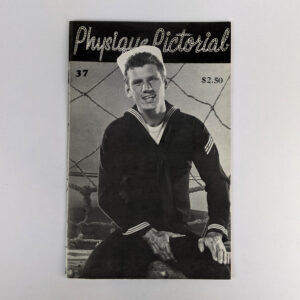
Physique Pictorial Volume 37, November 1982
AU$30 Read MoreAdd to cartBob Mizer
Los Angeles: Athletic Model Guild, 1982.Single 1980s issue of the most popular of beefcake magazines, Physique Pictorial, produced by Bob Mizer’s AMG. Early issues feature scantily clad athletic men in fitness poses together with homoerotic artwork by Tom of Finland, Harry Bush, George Quaintance, and others. If you can stayed focused the text provides insight into gay culture and rights at the time, as well as details on the models and artwork. Into the late 1960s and 1970s as the laws around censorship change, the beefcake physique magazine became more naked and blatantly homoerotic.
-
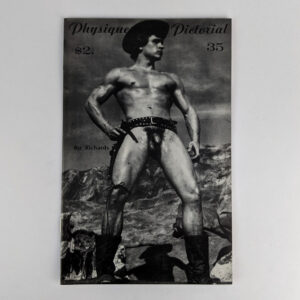
Physique Pictorial Volume 35, August 1981
AU$40 Read MoreAdd to cartBob Mizer
Los Angeles: Athletic Model Guild, 1981.Single 1980s issue of the most popular of beefcake magazines, Physique Pictorial, produced by Bob Mizer’s AMG. Early issues feature scantily clad athletic men in fitness poses together with homoerotic artwork by Tom of Finland, Harry Bush, George Quaintance, and others. If you can stayed focused the text provides insight into gay culture and rights at the time, as well as details on the models and artwork. Into the late 1960s and 1970s as the laws around censorship change, the beefcake physique magazine became more naked and blatantly homoerotic.
-
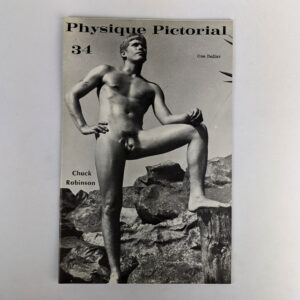
Physique Pictorial Volume 34, October 1980
AU$30 Read MoreAdd to cartBob Mizer
Los Angeles: Athletic Model Guild, 1980.Single 1980s issue of the most popular of beefcake magazines, Physique Pictorial, produced by Bob Mizer’s AMG. Early issues feature scantily clad athletic men in fitness poses together with homoerotic artwork by Tom of Finland, Harry Bush, George Quaintance, and others. If you can stayed focused the text provides insight into gay culture and rights at the time, as well as details on the models and artwork. Into the late 1960s and 1970s as the laws around censorship change, the beefcake physique magazine became more naked and blatantly homoerotic.
-
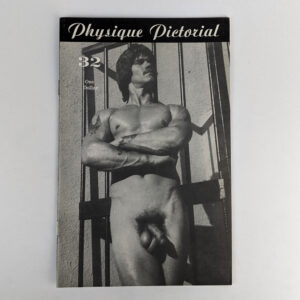
Physique Pictorial Volume 32, May 1979
AU$40 Read MoreAdd to cartBob Mizer
Los Angeles: Athletic Model Guild, 1979.Single 1970s issue of the most popular of beefcake magazines, Physique Pictorial, produced by Bob Mizer’s AMG. Early issues feature scantily clad athletic men in fitness poses together with homoerotic artwork by Tom of Finland, Harry Bush, George Quaintance, and others. If you can stayed focused the text provides insight into gay culture and rights at the time, as well as details on the models and artwork. Into the late 1960s and 1970s as the laws around censorship change, the beefcake physique magazine became more naked and blatantly homoerotic.
-
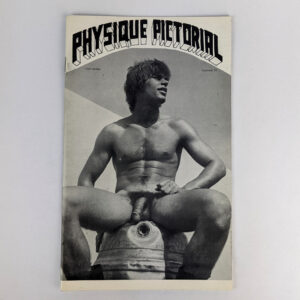
Physique Pictorial Volume 31, August 1978
AU$30 Read MoreAdd to cartBob Mizer
Los Angeles: Athletic Model Guild, 1978.Single 1970s issue of the most popular of beefcake magazines, Physique Pictorial, produced by Bob Mizer’s AMG. Early issues feature scantily clad athletic men in fitness poses together with homoerotic artwork by Tom of Finland, Harry Bush, George Quaintance, and others. If you can stayed focused the text provides insight into gay culture and rights at the time, as well as details on the models and artwork. Into the late 1960s and 1970s as the laws around censorship change, the beefcake physique magazine became more naked and blatantly homoerotic.
-
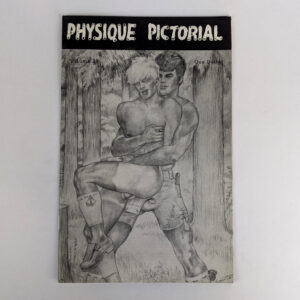
Physique Pictorial Volume 29, March 1977
AU$30 Read MoreAdd to cartBob Mizer
Los Angeles: Athletic Model Guild, 1977.Single 1970s issue of the most popular of beefcake magazines, Physique Pictorial, produced by Bob Mizer’s AMG. Early issues feature scantily clad athletic men in fitness poses together with homoerotic artwork by Tom of Finland, Harry Bush, George Quaintance, and others. If you can stayed focused the text provides insight into gay culture and rights at the time, as well as details on the models and artwork. Into the late 1960s and 1970s as the laws around censorship change, the beefcake physique magazine became more naked and blatantly homoerotic.
-
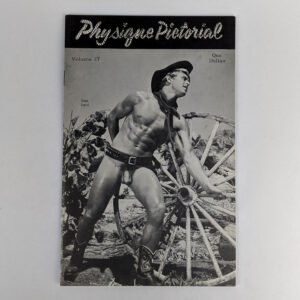
Physique Pictorial Volume 27, July 1975
AU$30 Read MoreAdd to cartBob Mizer
Los Angeles: Athletic Model Guild, 1975.Single 1970s issue of the most popular of beefcake magazines, Physique Pictorial, produced by Bob Mizer’s AMG. Early issues feature scantily clad athletic men in fitness poses together with homoerotic artwork by Tom of Finland, Harry Bush, George Quaintance, and others. If you can stayed focused the text provides insight into gay culture and rights at the time, as well as details on the models and artwork. Into the late 1960s and 1970s as the laws around censorship change, the beefcake physique magazine became more naked and blatantly homoerotic.
-
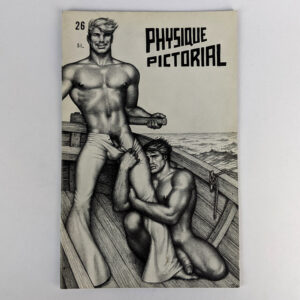
Physique Pictorial Volume 26, December 1974
AU$50 Read MoreAdd to cartBob Mizer
Los Angeles: Athletic Model Guild, 1974.Single 1970s issue of the most popular of beefcake magazines, Physique Pictorial, produced by Bob Mizer’s AMG. Early issues feature scantily clad athletic men in fitness poses together with homoerotic artwork by Tom of Finland, Harry Bush, George Quaintance, and others. If you can stayed focused the text provides insight into gay culture and rights at the time, as well as details on the models and artwork. Into the late 1960s and 1970s as the laws around censorship change, the beefcake physique magazine became more naked and blatantly homoerotic.
-
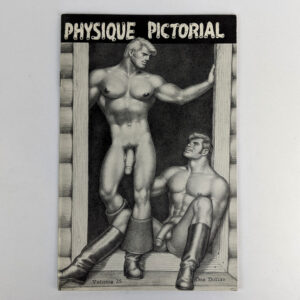
Physique Pictorial Volume 25, May 1974
AU$50 Read MoreAdd to cartBob Mizer
Los Angeles: Athletic Model Guild, 1974.Single 1970s issue of the most popular of beefcake magazines, Physique Pictorial, produced by Bob Mizer’s AMG. Early issues feature scantily clad athletic men in fitness poses together with homoerotic artwork by Tom of Finland, Harry Bush, George Quaintance, and others. If you can stayed focused the text provides insight into gay culture and rights at the time, as well as details on the models and artwork. Into the late 1960s and 1970s as the laws around censorship change, the beefcake physique magazine became more naked and blatantly homoerotic.
-
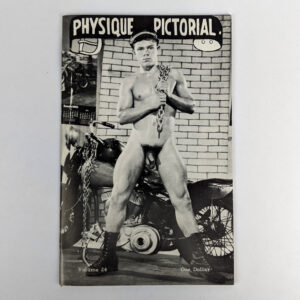
Physique Pictorial Volume 24, January 1974
AU$30 Read MoreAdd to cartBob Mizer
Los Angeles: Athletic Model Guild, 1974.Single 1970s issue of the most popular of beefcake magazines, Physique Pictorial, produced by Bob Mizer’s AMG. Early issues feature scantily clad athletic men in fitness poses together with homoerotic artwork by Tom of Finland, Harry Bush, George Quaintance, and others. If you can stayed focused the text provides insight into gay culture and rights at the time, as well as details on the models and artwork. Into the late 1960s and 1970s as the laws around censorship change, the beefcake physique magazine became more naked and blatantly homoerotic.
-
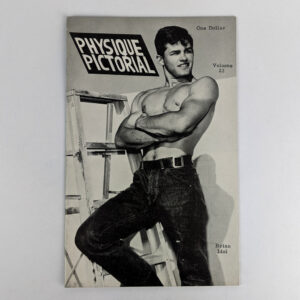
Physique Pictorial Volume 22, April 1973
AU$40 Read MoreAdd to cartBob Mizer
Los Angeles: Athletic Model Guild, 1973.Single 1970s issue of the most popular of beefcake magazines, Physique Pictorial, produced by Bob Mizer’s AMG. Early issues feature scantily clad athletic men in fitness poses together with homoerotic artwork by Tom of Finland, Harry Bush, George Quaintance, and others. If you can stayed focused the text provides insight into gay culture and rights at the time, as well as details on the models and artwork. Into the late 1960s and 1970s as the laws around censorship change, the beefcake physique magazine became more naked and blatantly homoerotic.
-
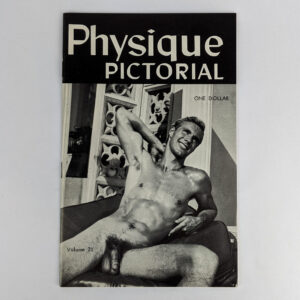
Physique Pictorial Volume 21, July 1972
AU$40 Read MoreAdd to cartBob Mizer
Los Angeles: Athletic Model Guild, 1972.Single 1970s issue of the most popular of beefcake magazines, Physique Pictorial, produced by Bob Mizer’s AMG. Early issues feature scantily clad athletic men in fitness poses together with homoerotic artwork by Tom of Finland, Harry Bush, George Quaintance, and others. If you can stayed focused the text provides insight into gay culture and rights at the time, as well as details on the models and artwork. Into the late 1960s and 1970s as the laws around censorship change, the beefcake physique magazine became more naked and blatantly homoerotic.
-
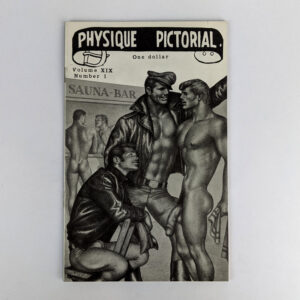
Physique Pictorial Volume 19 Number 1, June 1971
AU$40 Read MoreAdd to cartBob Mizer
Los Angeles: Athletic Model Guild, 1971.Single 1970s issue of the most popular of beefcake magazines, Physique Pictorial, produced by Bob Mizer’s AMG. Early issues feature scantily clad athletic men in fitness poses together with homoerotic artwork by Tom of Finland, Harry Bush, George Quaintance, and others. If you can stayed focused the text provides insight into gay culture and rights at the time, as well as details on the models and artwork. Into the late 1960s and 1970s as the laws around censorship change, the beefcake physique magazine became more naked and blatantly homoerotic.
-
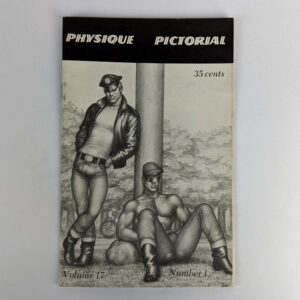
Physique Pictorial Volume 17 Number 1, July 1968
AU$50 Read MoreAdd to cartBob Mizer
Los Angeles: Athletic Model Guild, 1968.Single 1960s issue of the most popular of beefcake magazines, Physique Pictorial, produced by Bob Mizer’s AMG. Early issues feature scantily clad athletic men in fitness poses together with homoerotic artwork by Tom of Finland, Harry Bush, George Quaintance, and others. If you can stayed focused the text provides insight into gay culture and rights at the time, as well as details on the models and artwork. Into the late 1960s and 1970s as the laws around censorship change, the beefcake physique magazine became more naked and blatantly homoerotic.
-
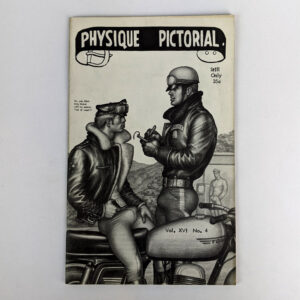
Physique Pictorial Volume 16 Number 4, February 1968
AU$50 Read MoreAdd to cartBob Mizer
Los Angeles: Athletic Model Guild, 1968.Single 1960s issue of the most popular of beefcake magazines, Physique Pictorial, produced by Bob Mizer’s AMG. Early issues feature scantily clad athletic men in fitness poses together with homoerotic artwork by Tom of Finland, Harry Bush, George Quaintance, and others. If you can stayed focused the text provides insight into gay culture and rights at the time, as well as details on the models and artwork. Into the late 1960s and 1970s as the laws around censorship change, the beefcake physique magazine became more naked and blatantly homoerotic.
-
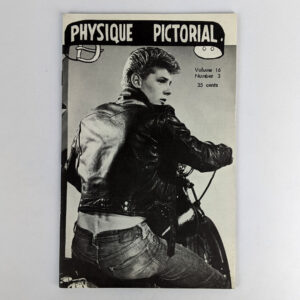
Physique Pictorial Volume 16 Number 3, September 1967
AU$50 Read MoreAdd to cartBob Mizer
Los Angeles: Athletic Model Guild, 1967.Single 1960s issue of the most popular of beefcake magazines, Physique Pictorial, produced by Bob Mizer’s AMG. Early issues feature scantily clad athletic men in fitness poses together with homoerotic artwork by Tom of Finland, Harry Bush, George Quaintance, and others. If you can stayed focused the text provides insight into gay culture and rights at the time, as well as details on the models and artwork. Into the late 1960s and 1970s as the laws around censorship change, the beefcake physique magazine became more naked and blatantly homoerotic.
-
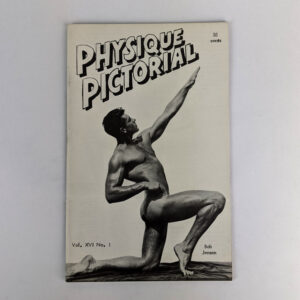
Physique Pictorial Volume 16 Number 1, December 1966
AU$40 Read MoreAdd to cartBob Mizer
Los Angeles: Athletic Model Guild, 1966.Single 1960s issue of the most popular of beefcake magazines, Physique Pictorial, produced by Bob Mizer’s AMG. Early issues feature scantily clad athletic men in fitness poses together with homoerotic artwork by Tom of Finland, Harry Bush, George Quaintance, and others. If you can stayed focused the text provides insight into gay culture and rights at the time, as well as details on the models and artwork. Into the late 1960s and 1970s as the laws around censorship change, the beefcake physique magazine became more naked and blatantly homoerotic.
-
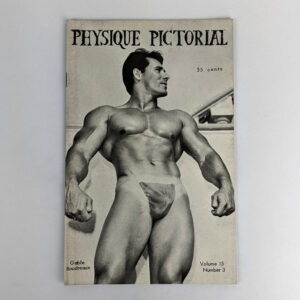
Physique Pictorial Volume 15 Number 4, September 1966
AU$40 Read MoreAdd to cartBob Mizer
Los Angeles: Athletic Model Guild, 1966.Single 1960s issue of the most popular of beefcake magazines, Physique Pictorial, produced by Bob Mizer’s AMG. Early issues feature scantily clad athletic men in fitness poses together with homoerotic artwork by Tom of Finland, Harry Bush, George Quaintance, and others. If you can stayed focused the text provides insight into gay culture and rights at the time, as well as details on the models and artwork. Into the late 1960s and 1970s as the laws around censorship change, the beefcake physique magazine became more naked and blatantly homoerotic. Vol. 15 No. 4 incorrectly printed as Number 3 on the cover, but with correct numbering on interior.
-
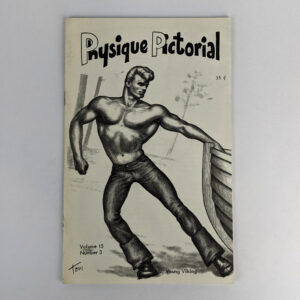
Physique Pictorial Volume 15 Number 3, June 1966
AU$40 Read MoreAdd to cartBob Mizer
Los Angeles: Athletic Model Guild, 1966.Single 1960s issue of the most popular of beefcake magazines, Physique Pictorial, produced by Bob Mizer’s AMG. Early issues feature scantily clad athletic men in fitness poses together with homoerotic artwork by Tom of Finland, Harry Bush, George Quaintance, and others. If you can stayed focused the text provides insight into gay culture and rights at the time, as well as details on the models and artwork. Into the late 1960s and 1970s as the laws around censorship change, the beefcake physique magazine became more naked and blatantly homoerotic.
-
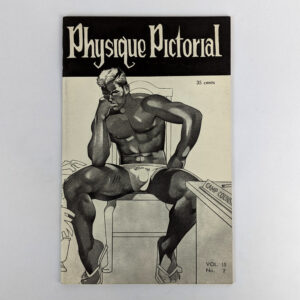
Physique Pictorial Volume 15 Number 2, January 1966
AU$40 Read MoreAdd to cartBob Mizer
Los Angeles: Athletic Model Guild, 1966.Single 1960s issue of the most popular of beefcake magazines, Physique Pictorial, produced by Bob Mizer’s AMG. Early issues feature scantily clad athletic men in fitness poses together with homoerotic artwork by Tom of Finland, Harry Bush, George Quaintance, and others. If you can stayed focused the text provides insight into gay culture and rights at the time, as well as details on the models and artwork. Into the late 1960s and 1970s as the laws around censorship change, the beefcake physique magazine became more naked and blatantly homoerotic.
-
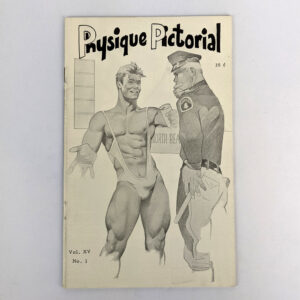
Physique Pictorial Volume 15 Number 1, October 1965
AU$40 Read MoreAdd to cartBob Mizer
Los Angeles: Athletic Model Guild, 1965.Single 1960s issue of the most popular of beefcake magazines, Physique Pictorial, produced by Bob Mizer’s AMG. Early issues feature scantily clad athletic men in fitness poses together with homoerotic artwork by Tom of Finland, Harry Bush, George Quaintance, and others. If you can stayed focused the text provides insight into gay culture and rights at the time, as well as details on the models and artwork. Into the late 1960s and 1970s as the laws around censorship change, the beefcake physique magazine became more naked and blatantly homoerotic.
-
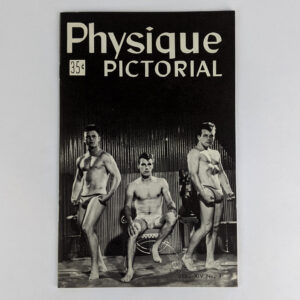
Physique Pictorial Volume 14 Number 4, June 1965
AU$40 Read MoreAdd to cartBob Mizer
Los Angeles: Athletic Model Guild, 1965.Single 1960s issue of the most popular of beefcake magazines, Physique Pictorial, produced by Bob Mizer’s AMG. Early issues feature scantily clad athletic men in fitness poses together with homoerotic artwork by Tom of Finland, Harry Bush, George Quaintance, and others. If you can stayed focused the text provides insight into gay culture and rights at the time, as well as details on the models and artwork. Into the late 1960s and 1970s as the laws around censorship change, the beefcake physique magazine became more naked and blatantly homoerotic.
-
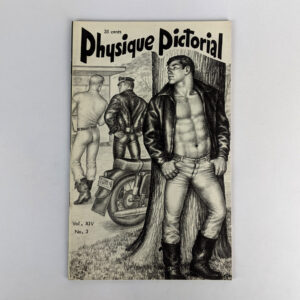
Physique Pictorial Volume 14 Number 3, February 1965
AU$40 Read MoreAdd to cartBob Mizer
Los Angeles: Athletic Model Guild, 1965.Single 1960s issue of the most popular of beefcake magazines, Physique Pictorial, produced by Bob Mizer’s AMG. Early issues feature scantily clad athletic men in fitness poses together with homoerotic artwork by Tom of Finland, Harry Bush, George Quaintance, and others. If you can stayed focused the text provides insight into gay culture and rights at the time, as well as details on the models and artwork. Into the late 1960s and 1970s as the laws around censorship change, the beefcake physique magazine became more naked and blatantly homoerotic.
-
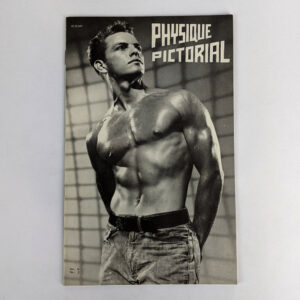
Physique Pictorial Volume 14 Number 2, October 1964
AU$40 Read MoreAdd to cartBob Mizer
Los Angeles: Athletic Model Guild, 1964.Single 1960s issue of the most popular of beefcake magazines, Physique Pictorial, produced by Bob Mizer’s AMG. Early issues feature scantily clad athletic men in fitness poses together with homoerotic artwork by Tom of Finland, Harry Bush, George Quaintance, and others. If you can stayed focused the text provides insight into gay culture and rights at the time, as well as details on the models and artwork. Into the late 1960s and 1970s as the laws around censorship change, the beefcake physique magazine became more naked and blatantly homoerotic.
-
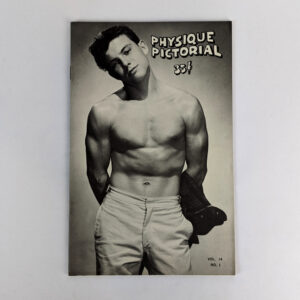
Physique Pictorial Volume 14 Number 1, July 1964
AU$50 Read MoreAdd to cartBob Mizer
Los Angeles: Athletic Model Guild, 1964.Single 1960s issue of the most popular of beefcake magazines, Physique Pictorial, produced by Bob Mizer’s AMG. Early issues feature scantily clad athletic men in fitness poses together with homoerotic artwork by Tom of Finland, Harry Bush, George Quaintance, and others. If you can stayed focused the text provides insight into gay culture and rights at the time, as well as details on the models and artwork. Into the late 1960s and 1970s as the laws around censorship change, the beefcake physique magazine became more naked and blatantly homoerotic.
-
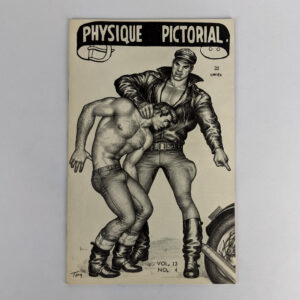
Physique Pictorial Volume 13 Number 4, May 1964
AU$50 Read MoreAdd to cartBob Mizer
Los Angeles: Athletic Model Guild, 1964.Single 1960s issue of the most popular of beefcake magazines, Physique Pictorial, produced by Bob Mizer’s AMG. Early issues feature scantily clad athletic men in fitness poses together with homoerotic artwork by Tom of Finland, Harry Bush, George Quaintance, and others. If you can stayed focused the text provides insight into gay culture and rights at the time, as well as details on the models and artwork. Into the late 1960s and 1970s as the laws around censorship change, the beefcake physique magazine became more naked and blatantly homoerotic.
-
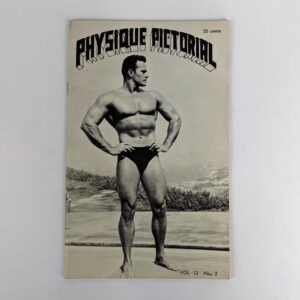
Physique Pictorial Volume 13 Number 3, February 1964
AU$40 Read MoreAdd to cartBob Mizer
Los Angeles: Athletic Model Guild, 1964.Single 1960s issue of the most popular of beefcake magazines, Physique Pictorial, produced by Bob Mizer’s AMG. Early issues feature scantily clad athletic men in fitness poses together with homoerotic artwork by Tom of Finland, Harry Bush, George Quaintance, and others. If you can stayed focused the text provides insight into gay culture and rights at the time, as well as details on the models and artwork. Into the late 1960s and 1970s as the laws around censorship change, the beefcake physique magazine became more naked and blatantly homoerotic. Volume 13 Number 3 states published Feb ’63 but is Feb ’64.
-
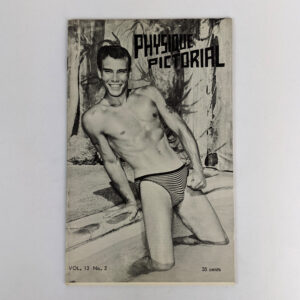
Physique Pictorial Volume 13 Number 2, October 1963
AU$40 Read MoreAdd to cartBob Mizer
Los Angeles: Athletic Model Guild, 1963.Single 1960s issue of the most popular of beefcake magazines, Physique Pictorial, produced by Bob Mizer’s AMG. Early issues feature scantily clad athletic men in fitness poses together with homoerotic artwork by Tom of Finland, Harry Bush, George Quaintance, and others. If you can stayed focused the text provides insight into gay culture and rights at the time, as well as details on the models and artwork. Into the late 1960s and 1970s as the laws around censorship change, the beefcake physique magazine became more naked and blatantly homoerotic.
-
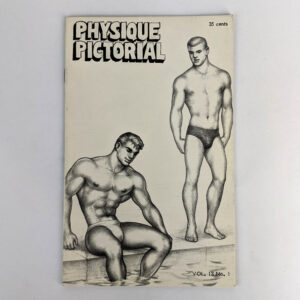
Physique Pictorial Volume 13 Number 1, August 1963
AU$40 Read MoreAdd to cartBob Mizer
Los Angeles: Athletic Model Guild, 1963.Single 1960s issue of the most popular of beefcake magazines, Physique Pictorial, produced by Bob Mizer’s AMG. Early issues feature scantily clad athletic men in fitness poses together with homoerotic artwork by Tom of Finland, Harry Bush, George Quaintance, and others. If you can stayed focused the text provides insight into gay culture and rights at the time, as well as details on the models and artwork. Into the late 1960s and 1970s as the laws around censorship change, the beefcake physique magazine became more naked and blatantly homoerotic.
-
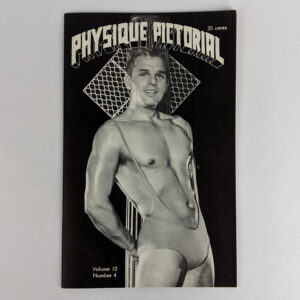
Physique Pictorial Volume 12 Number 4, May 1963
AU$40 Read MoreAdd to cartBob Mizer
Los Angeles: Athletic Model Guild, 1963.Single 1960s issue of the most popular of beefcake magazines, Physique Pictorial, produced by Bob Mizer’s AMG. Early issues feature scantily clad athletic men in fitness poses together with homoerotic artwork by Tom of Finland, Harry Bush, George Quaintance, and others. If you can stayed focused the text provides insight into gay culture and rights at the time, as well as details on the models and artwork. Into the late 1960s and 1970s as the laws around censorship change, the beefcake physique magazine became more naked and blatantly homoerotic.
-
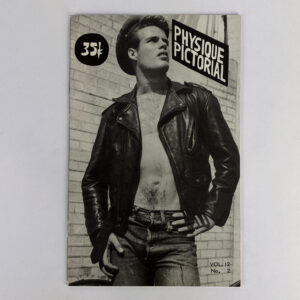
Physique Pictorial Volume 12 Number 2, November 1962
AU$50 Read MoreAdd to cartBob Mizer
Los Angeles: Athletic Model Guild, 1962.Single 1960s issue of the most popular of beefcake magazines, Physique Pictorial, produced by Bob Mizer’s AMG. Early issues feature scantily clad athletic men in fitness poses together with homoerotic artwork by Tom of Finland, Harry Bush, George Quaintance, and others. If you can stayed focused the text provides insight into gay culture and rights at the time, as well as details on the models and artwork. Into the late 1960s and 1970s as the laws around censorship change, the beefcake physique magazine became more naked and blatantly homoerotic.
-
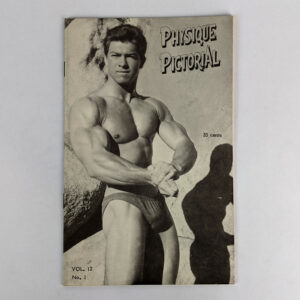
Physique Pictorial Volume 12 Number 1, July 1962
AU$40 Read MoreAdd to cartBob Mizer
Los Angeles: Athletic Model Guild, 1962.Single 1960s issue of the most popular of beefcake magazines, Physique Pictorial, produced by Bob Mizer’s AMG. Early issues feature scantily clad athletic men in fitness poses together with homoerotic artwork by Tom of Finland, Harry Bush, George Quaintance, and others. If you can stayed focused the text provides insight into gay culture and rights at the time, as well as details on the models and artwork. Into the late 1960s and 1970s as the laws around censorship change, the beefcake physique magazine became more naked and blatantly homoerotic.
-
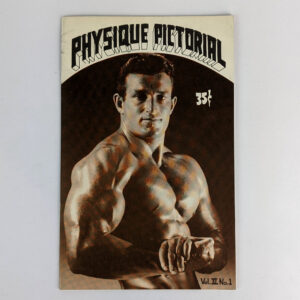
Physique Pictorial Volume 11 Number 1, August 1961
AU$50 Read MoreAdd to cartBob Mizer
Los Angeles: Athletic Model Guild, 1961.Single 1960s issue of the most popular of beefcake magazines, Physique Pictorial, produced by Bob Mizer’s AMG. Early issues feature scantily clad athletic men in fitness poses together with homoerotic artwork by Tom of Finland, Harry Bush, George Quaintance, and others. If you can stayed focused the text provides insight into gay culture and rights at the time, as well as details on the models and artwork. Into the late 1960s and 1970s as the laws around censorship change, the beefcake physique magazine became more naked and blatantly homoerotic.
-
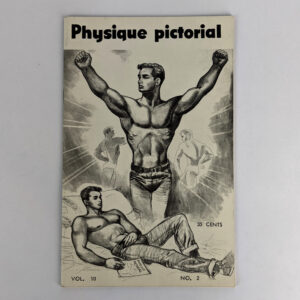
Physique Pictorial Volume 10 Number 2, August 1960
AU$50 Read MoreAdd to cartBob Mizer
Los Angeles: Athletic Model Guild, 1960.Single 1960s issue of the most popular of beefcake magazines, Physique Pictorial, produced by Bob Mizer’s AMG. Early issues feature scantily clad athletic men in fitness poses together with homoerotic artwork by Tom of Finland, Harry Bush, George Quaintance, and others. If you can stayed focused the text provides insight into gay culture and rights at the time, as well as details on the models and artwork. Into the late 1960s and 1970s as the laws around censorship change, the beefcake physique magazine became more naked and blatantly homoerotic.
-
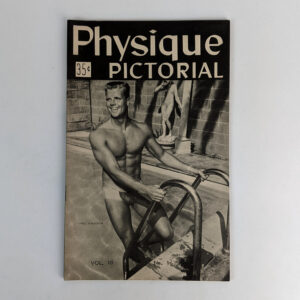
Physique Pictorial Volume 10 Number 1, June 1960
AU$50 Read MoreAdd to cartBob Mizer
Los Angeles: Athletic Model Guild, 1960.Single 1960s issue of the most popular of beefcake magazines, Physique Pictorial, produced by Bob Mizer’s AMG. Early issues feature scantily clad athletic men in fitness poses together with homoerotic artwork by Tom of Finland, Harry Bush, George Quaintance, and others. If you can stayed focused the text provides insight into gay culture and rights at the time, as well as details on the models and artwork. Into the late 1960s and 1970s as the laws around censorship change, the beefcake physique magazine became more naked and blatantly homoerotic.
-
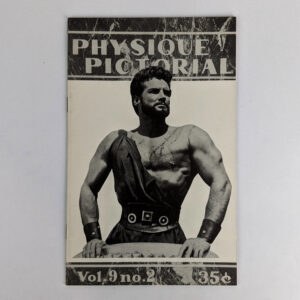
Physique Pictorial Volume 9 Number 2, Summer 1959
AU$50 Read MoreAdd to cartBob Mizer
Los Angeles: Athletic Model Guild, 1959.Single 1950s issue of the most popular of beefcake magazines, Physique Pictorial, produced by Bob Mizer’s AMG. Early issues feature scantily clad athletic men in fitness poses together with homoerotic artwork by Tom of Finland, Harry Bush, George Quaintance, and others. If you can stayed focused the text provides insight into gay culture and rights at the time, as well as details on the models and artwork. Into the late 1960s and 1970s as the laws around censorship change, the beefcake physique magazine became more naked and blatantly homoerotic.
-
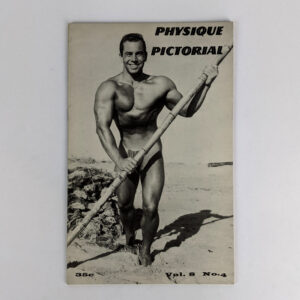
Physique Pictorial Volume 8 Number 4, Winter 1958
AU$50 Read MoreAdd to cartBob Mizer
Los Angeles: Athletic Model Guild, 1959.Single 1950s issue of the most popular of beefcake magazines, Physique Pictorial, produced by Bob Mizer’s AMG. Early issues feature scantily clad athletic men in fitness poses together with homoerotic artwork by Tom of Finland, Harry Bush, George Quaintance, and others. If you can stayed focused the text provides insight into gay culture and rights at the time, as well as details on the models and artwork. Into the late 1960s and 1970s as the laws around censorship change, the beefcake physique magazine became more naked and blatantly homoerotic. The Winter 1958 issue was released in March 1959.
-
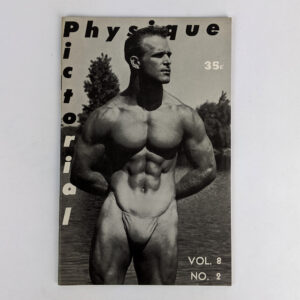
Physique Pictorial Volume 8 Number 2, Summer 1958
AU$50 Read MoreAdd to cartBob Mizer
Los Angeles: Athletic Model Guild, 1958.Single 1950s issue of the most popular of beefcake magazines, Physique Pictorial, produced by Bob Mizer’s AMG. Early issues feature scantily clad athletic men in fitness poses together with homoerotic artwork by Tom of Finland, Harry Bush, George Quaintance, and others. If you can stayed focused the text provides insight into gay culture and rights at the time, as well as details on the models and artwork. Into the late 1960s and 1970s as the laws around censorship change, the beefcake physique magazine became more naked and blatantly homoerotic.
-
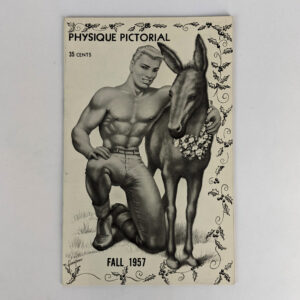
Physique Pictorial Volume 7 Number 3, Fall 1957
AU$50 Read MoreAdd to cartBob Mizer
Los Angeles: Athletic Model Guild, 1957.Single 1950s issue of the most popular of beefcake magazines, Physique Pictorial, produced by Bob Mizer’s AMG. Early issues feature scantily clad athletic men in fitness poses together with homoerotic artwork by Tom of Finland, Harry Bush, George Quaintance, and others. If you can stayed focused the text provides insight into gay culture and rights at the time, as well as details on the models and artwork. Into the late 1960s and 1970s as the laws around censorship change, the beefcake physique magazine became more naked and blatantly homoerotic.
-
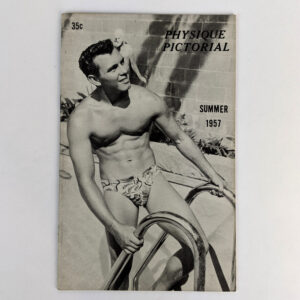
Physique Pictorial Volume 7 Number 2, Summer 1957
AU$50 Read MoreAdd to cartBob Mizer
Los Angeles: Athletic Model Guild, 1957.Single 1950s issue of the most popular of beefcake magazines, Physique Pictorial, produced by Bob Mizer’s AMG. Early issues feature scantily clad athletic men in fitness poses together with homoerotic artwork by Tom of Finland, Harry Bush, George Quaintance, and others. If you can stayed focused the text provides insight into gay culture and rights at the time, as well as details on the models and artwork. Into the late 1960s and 1970s as the laws around censorship change, the beefcake physique magazine became more naked and blatantly homoerotic.
-
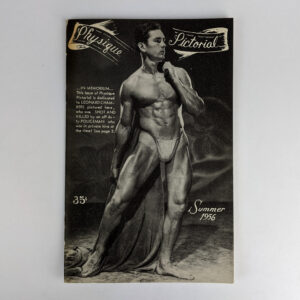
Physique Pictorial Volume 6 Number 2, Summer 1956
AU$50 Read MoreAdd to cartBob Mizer
Los Angeles: Athletic Model Guild, 1956.Single 1950s issue of the most popular of beefcake magazines, Physique Pictorial, produced by Bob Mizer’s AMG. Early issues feature scantily clad athletic men in fitness poses together with homoerotic artwork by Tom of Finland, Harry Bush, George Quaintance, and others. If you can stayed focused the text provides insight into gay culture and rights at the time, as well as details on the models and artwork. Into the late 1960s and 1970s as the laws around censorship change, the beefcake physique magazine became more naked and blatantly homoerotic.
-
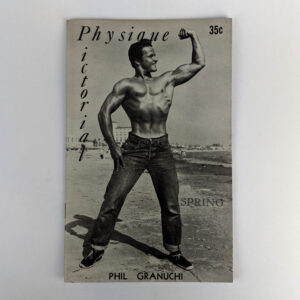
Physique Pictorial Volume 6 Number 1, Spring 1956
AU$40 Read MoreAdd to cartBob Mizer
Los Angeles: Athletic Model Guild, 1956.Single 1950s issue of the most popular of beefcake magazines, Physique Pictorial, produced by Bob Mizer’s AMG. Early issues feature scantily clad athletic men in fitness poses together with homoerotic artwork by Tom of Finland, Harry Bush, George Quaintance, and others. If you can stayed focused the text provides insight into gay culture and rights at the time, as well as details on the models and artwork. Into the late 1960s and 1970s as the laws around censorship change, the beefcake physique magazine became more naked and blatantly homoerotic.
-
![The Male Figure Volume Thirty-Five [35]](https://www.thebookmerchantjenkins.com/wp-content/uploads/0031931-300x300.jpg)
The Male Figure Volume Thirty-Five [35]
AU$40 Read MoreAdd to cartBruce of Los Angeles
Los Angeles: Bruce of Los Angeles, 1966.The penultimate issue of physique photography of LA bodybuilders by Bruce Bellas (1909-1974), more commonly known as Bruce of Los Angeles. The final two issues in a slightly larger format. In this issue: John Bennett, Billy Parks, Ralph Kleiner, Frank Nisi, Big John Clark, Tom Vanselow, Jerry Rogers by Mel Roberts, Chuck Baker by Milo, Dale Hepburn, John Quincy Adams by Milo, Bill Melby, Bob Jackson, Dean Densman, Dennis Densman, LeRoy Williams & Elmer Matt.
-
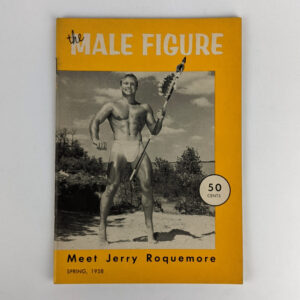
The Male Figure Volume VIII, Spring, 1958
AU$40 Read MoreAdd to cartBruce of Los Angeles
Los Angeles: Bruce of Los Angeles, 1958.Single issue of physique photography of LA bodybuilders by Bruce Bellas (1909-1974), more commonly known as Bruce of Los Angeles. In this issue: Meet Jerry Roquemore, Mr. Apollo contest, Edgar Hayes, Harry Miller, Cowboys of the West, and Steven Wengryn.
-
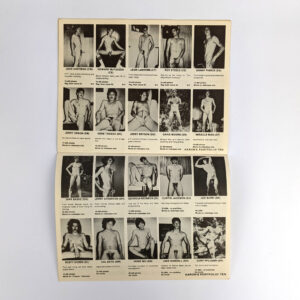
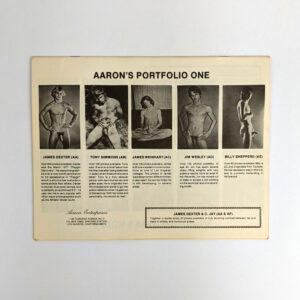
Aaron’s Portfolio One to Eleven
AU$40 Read MoreAdd to cartAaron Enterprises
Los Angeles: Aaron Enterprises, No date.Catalogue of mail order erotic gay male photos and films. Each portfolio is a double-sided leaf except portfolio ten which is 4 pages, containing nude black and white stills and ordering details. Aaron Enterprises was an American studio producing erotic gay films from the 1970s through to the early 1990s.
-

Out of the Ordinary: A Life of Gender and Spiritual Transitions
AU$50 Read MoreAdd to cartMichael Dillon; Lobzang Jivaka
New York: Fordham University Press, 2017.“Now available for the first time–more than 50 years after it was written–is the memoir of Michael Dillon/Lobzang Jivaka (1915-62), the British doctor and Buddhist monastic novice chiefly known to scholars of sex, gender, and sexuality for his pioneering transition from female to male between 1939 and 1949, and for his groundbreaking 1946 book Self: A Study in Ethics and Endocrinology. Here at last is Dillon/Jivaka’s extraordinary life story told in his own words. Out of the Ordinary captures Dillon/Jivaka’s various journeys–to Oxford, into medicine, across the world by ship–within the major narratives of his gender and religious journeys. Moving chronologically, Dillon/Jivaka begins with his childhood in Folkestone, England, where he was raised by his spinster aunts, and tells of his days at Oxford immersed in theology, classics, and rowing. He recounts his hormonal transition while working as an auto mechanic and fire watcher during World War II and his surgical transition under Sir Harold Gillies while Dillon himself attended medical school. He details his worldwide travel as a ship’s surgeon in the British Merchant Navy with extensive commentary on his interactions with colonial and postcolonial subjects, followed by his “outing” by the British press while he was serving aboard The City of Bath. Out of the Ordinary is not only a salient record of an early sex transition but also a unique account of religious conversion in the mid-twentieth century. Dillon/Jivaka chronicles his gradual shift from Anglican Christianity to the esoteric spiritual systems of George Gurdjieff and Peter Ouspensky to Theravada and finally Mahayana Buddhism. He concludes his memoir with the contested circumstances of his Buddhist monastic ordination in India and Tibet. Ultimately, while Dillon/Jivaka died before becoming a monk, his novice ordination was significant: It made him the first white European man to be ordained in the Tibetan Buddhist tradition. Out of the Ordinary is a landmark publication that sets free a distinct voice from the history of the transgender movement.” (publisher’s blurb)
-
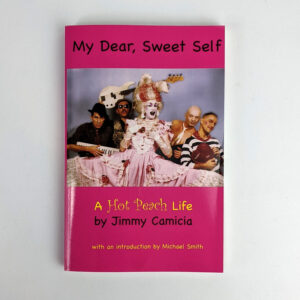
My Dear, Sweet Self: A Hot Peach Life
AU$30 Read MoreAdd to cartJimmy Camicia
Silverton: Fast Books, 2013.Biography of Jimmy Camicia, founder of New York drag performance group, Hot Peaches.
-

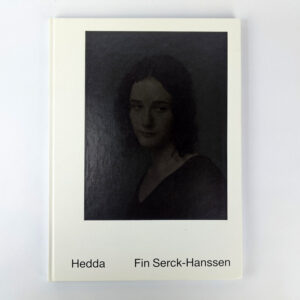
Hedda
AU$90 Read MoreAdd to cartFin Serck-Hanssen
[Marseille]: Loose Joints, 2021.“Over the last five years, Norwegian artist Fin Serck-Hanssen followed and documented the gender transitioning journey of close friend Hedda, who from her early twenties travelled from Oslo to Buenos Aires and Bangkok to undergo cosmetic surgeries and a vaginoplasty. Serck-Hansen and Heddas images are made collaboratively to build a complex portrait of both physical and psychological change within a young persons life, and show with unflinching honesty the realities of Heddas transitioning, surgeries, and recovery. Hedda reflects on the psychological construction of identity in the 21st century, mixing her selfies and curation of an online identity against Serck-Hansens tender but direct portraiture of her most vulnerable moments.” (publisher’s blurb)
-
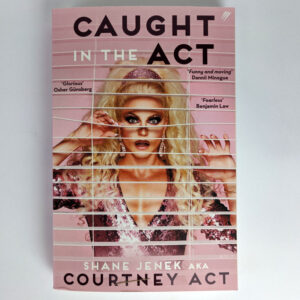
Caught in the Act: A Memoir
AU$30 Read MoreAdd to cartShane Jenek AKA Courtney Act
Sydney: Pantera Press, 2021.“Boy, girl, artist, advocate. Courtney is more than the sum of her parts. Meet Shane Jenek: Raised in the Brisbane suburbs by loving parents, Shane realises from a young age that he’s not like all the other boys. He finds his tribe at a performing arts agency, where he discovers his passion for song, dance and performance. Shane makes a promise to himself- to find a bigger stage. Meet Courtney Act: Born in Sydney around the turn of the millennium, Courtney makes her name in the gay bars of Oxford Street and then on Australian Idol. Over ten years later, she makes star turns on RuPaul’s Drag Race and Celebrity Big Brother UK, bringing her unique take on drag and gender to the world. Behind this rise to national and global fame is a story of searching for and finding oneself. Told with Courtney’s trademark candour and wit, Caught in the Act is about our journey towards understanding gender, sexuality and identity. It’s an often hilarious and at times heartbreaking memoir from a beloved drag and entertainment icon. Most of all, it’s a bloody good time. (publisher’s blurb)
-
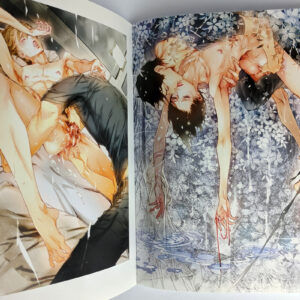

Aphrodisiacs: The World of Ayumi Kasai
AU$75 Read MoreAdd to cartAyumi Kasai
Tokyo: PIE International, 2021.“Ayumi Kasai is a pioneer and one of the most popular artists in the genre of yaoi, or Boys Love. This book contains illustrations from Kasai’s yaoi novels over the past 10 years, as well as her original work in the “Dannahan to Chiwagenka (The Husband & Lovers Fight)” series and a selection of illustrations specially drawn for the publication. On every page you can enjoy Kasai’s world of aestheticbeauty and eroticism. Contains explicit sexual scenes.” (publisher’s blurb)
-
Paris Nights: Sydney, Oxford St, Mid 80’s Sex, Drugs & Clubbing
AU$25 Read MoreAdd to cartD. M. Crawford
Sydney: D M Crawford, 2020.A semi-biographical story of sex, drugs, and clubbing in Sydney, Oxford Street, mid-80’s. “Mark was a closeted suburban boy from Wollongong, hiding his sexuality within his surroundings. The enticing allure of Oxford Street nightlife beckoned and in particular a legendary nightclub called Patchs. A semi-biographical account of a young man’s journey and self-discovery which leads to a chance encounter as he hooks up with an older guy called Matt Paris, who’s been around the traps and harboured a secret past. They form a complicated friendship and bond as they embark on a shared weekend life together. Both men were from vastly different backgrounds, experiencing the highs and lows of gay life on Oxford Street in the mid to late ’80s of sex, drugs and clubbing. Oxford Street was called Sydney’s ‘Gay Golden Mile’. A beehive of social activities gathered on this strip that glittered with life and a party atmosphere catering for everyone’s tastes and fantasies. The DJ’s in these establishments were the Gods of the dance floor, playing an accompanying soundtrack to your life. This was Mark’s story and experience!” (publisher’s blurb)
-
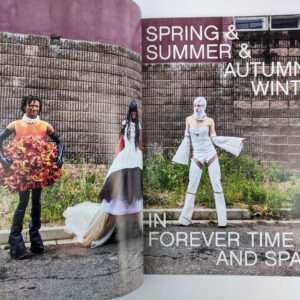
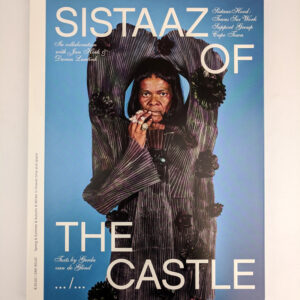
Sistaaz of the Castle: SistaazHood: Trans Sex Work Support Group, Cape Town
AU$48 Read MoreAdd to cartJan Hoek; Duran Lantink; Gerda van de Glind; SistaazHood
[Ghent]: Art Paper Editions, 2019.“Jan Hoek, fashion designer Duran Lantink and trans sex worker organisation SistaazHood present Sistaaz of the Castle, an ongoing project about the colorful looks and lives of transgender sex workers that roam the streets of Cape Town, South Africa. Most of the girls are homeless, living under a bridge near Cape Towns castle. The Sistaaz are eager activists, proud to be trans, proud to be a sex worker, and even prouder of their stunning sense of style. And they want it to be acknowledged. A series of photographs and a fashion collection based on the girls appearance and their ability to turn whatever they find into the most exuberant outfits was created. This has already resulted in a fashion show at Amsterdam Fashion Week (a show in Cape Town in still on the wish list) and a photo exhibition in Foam Amsterdam.” (publisher’s blurb)
-
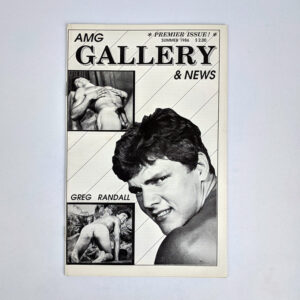
AMG Gallery & News: Premiere Issue! Summer 1986
AU$20 Read MoreAdd to cartJohn-Paul Kennington; Bob Mizer
Los Angeles: Athletic Model Guild, 1986.Catalogue of models from the later blatantly homoerotic years of Bob Mizer’s AMG, the physique photography powerhouse behind the most popular of beefcake magazines. Early issues feature scantily clad athletic men in fitness poses together with homoerotic artwork by Tom of Finland, Harry Bush, George Quaintance, and others. If you can stayed focused the text provides insight into gay culture and rights at the time, as well as details on the models and artwork. Into the late 1960s and 1970s as the laws around censorship change, the beefcake physique magazine became more naked and blatantly homoerotic.
-

The Male Homosexual In Literature: A Bibliography
AU$60 Read MoreAdd to cartIan Young
Los Angeles and Toronto: ReQueered Tales, 2020.This edition is identical to the second edition published by Scarecrow Press in 1982. It has been reset but the core content has not changed.
-

The Male Homosexual In Literature: A Bibliography (Supplement)
AU$45 Read MoreAdd to cartIan Young
Los Angeles and Toronto: ReQueered Tales, 2020.Includes titles overlooked in the Second Edition, plus works written before the 1981 cut-off date but published later, including works published for the first time in book form. It also includes four appendixes: a checklist, a guide to pen-names, and personal essays.
-

Murder and Mayhem: An Annotated Bibliography of Gay and Queer Males in Mystery, 1909-2018
AU$60 Read MoreAdd to cartMatt Lubbers-Moore
Los Angeles and Toronto: ReQueered Tales, 2020. -
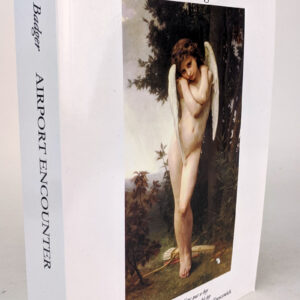
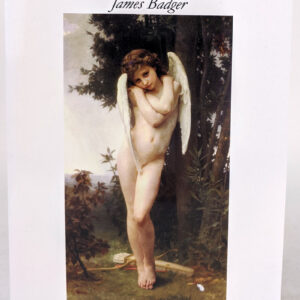
Airport Encounter
AU$30 Read MoreAdd to cartJames Badger
: Privately Printed, 2012.Erotic coming of age fiction with some homosexual themes set in Brisbane, Armidale, and Toulouse. Limited private printing of 100 copies. “Nigel Wellesley is an Australian choirboy and this book follows him and his talented group of friends from their first sexual experiences into being teenagers. The action switches between Brisbane, Armidale and Toulouse as Nigel has to cope with his girlfriend Jane Barton being in a different city, and then in a different country, but he has plenty of sex-play with his fellow boys while they are separated. Music naturally plays a major part in the story. Mark Ambon is a talented composer and his very shy girlfriend Rose Trescowick is a poet, while Andy Riemer (son of a jazz musician) juggles being a child prodigy pianist with surfing. All of these have major parts in the plot, as do a dirt-poor Moroccan immigrant family in Armidale who Nigel and Jane befriend. A heart-warming, and quite sexually explicit, story.” (publisher’s blurb)
-
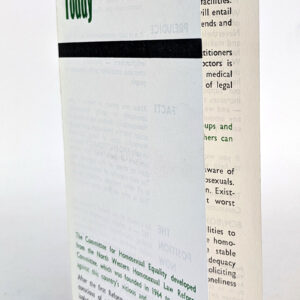
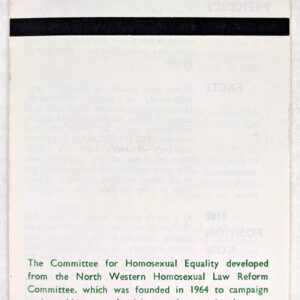
Homosexuals Today
AU$10 Read MoreAdd to cartCommittee for Homosexual Equality
London: Committee for Homosexual Equality, 1969.1969 promotional pamphlet of the Committee for Homosexual Equality.
-
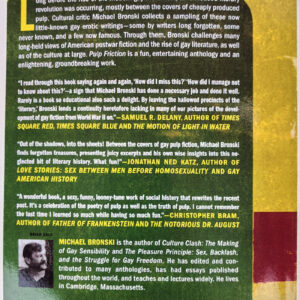
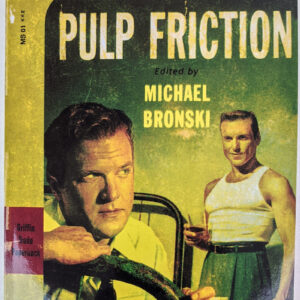
Pulp Friction: Uncovering the Golden Age of Gay Male Pulps
AU$35 Read MoreAdd to cartMichael Bronski
New York: St. Martin’s Griffin, 2002.“An anthology of early gay erotic writings ranges from the post-World War II era to the birth of the modern gay rights movement in the late 1960s.” (publisher’s blurb)
-
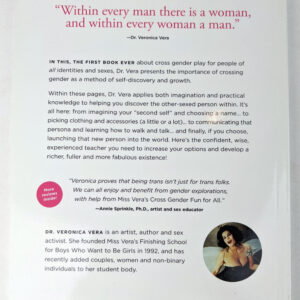
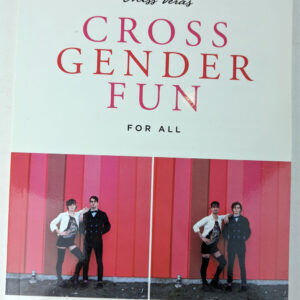
Miss Vera’s Cross Gender Fun For All
AU$30 Read MoreAdd to cartVeronica Vera
Oakland: Greenery Press, 2016. -


Claiming the B in LGBT: Illuminating the Bisexual Narrative
AU$35 Read MoreAdd to cartKate Harrad
Portland: Thorntree Press, 2018.