
Prices in AUD. Free Australian delivery for orders over $400. Free international delivery for orders over $800. Read full terms.
Showing 21–40 of 77 resultsSorted by latest
-
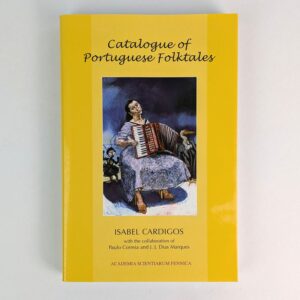
Catalogue of Portuguese Folktales
AU$60 Read MoreAdd to cartIsabel Cardigos; Paul Correia; J. J. Dias Marques
Helskinki: Suomalainen Tiedeakatemia, 2006.In the old Aarne / Thompson, Portugal was virtually non-existent, appearing in the bibliography of just three folktales. In 2003, the author of The Types of International Folktales stretched his hand to the first manuscript of the Catalogue of Portuguese Folktales and included them in 700 types of his own manuscript. The Catalogue of Portuguese Folktales is now the first regional index that takes into account the classifications of the new ‘ATU’. But it displays its difference by electing its own affinities with old ‘AT’ numbers, with regional catalogues, or even by offering new numbers. We can see a new face of the European folktale emerging, with a strong Mediterranean flavour. FF Communications No. 291 published by the Finnish Academy of Science and Letters.
-
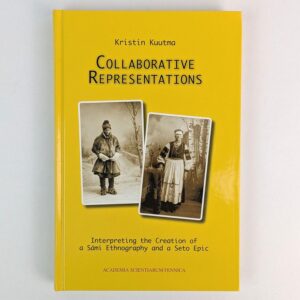
Collaborative Representations: Interpreting the Creation of a Sami Ethnography and a Seto Epic
AU$60 Read MoreAdd to cartKristin Kuutama
Helskinki: Suomalainen Tiedeakatemia, 2006.The focus of this book revolves around two manifestly representative texts from the early twentieth century: Johan Turi’s story of Sami experience Muitalus samiid birra and the Seto epic Peko performed by Anne Vabarna. The current analysis of the complex performative interaction between the culture bearer, his or her repertoire, and the culture researcher benefits from an interdisciplinary anthropological and folkloristic approach, informed by hybridity and the blurring of disciplinary boundaries in historicizing inquiries into cultural documentation and textual practices. FF Communications No. 289 published by the Finnish Academy of Science and Letters.
-
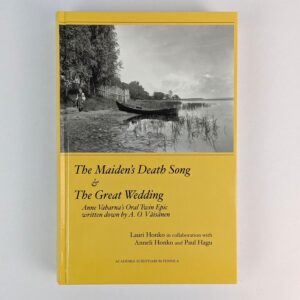
The Maiden’s Death Song & The Great Wedding: Anne Vabarna’s Oral Twin Epic written down by A. O. Vaisanen
AU$80 Read MoreAdd to cartLauri Honko; Anneli Honko; Paul Hagu
Helskinki: Suomalainen Tiedeakatemia, 2003.For centuries, the eastern shores of the Baltic Sea have nourished poetic cultures developing oral epic traditions that mostly survived in lays of a few hundred lines but that eventually gave rise to much longer traditional epics. The Maiden’s Death Song & The Great Wedding is a manifestation of a long epic format rare in Baltic-Finnish folk poetry and of two alternative storylines. It is also a masterpiece that serves as a reminder of the poetry of a gifted minority culture that tends to be forgotten. FF Communications No. 281 published by the Finnish Academy of Science and Letters.
-
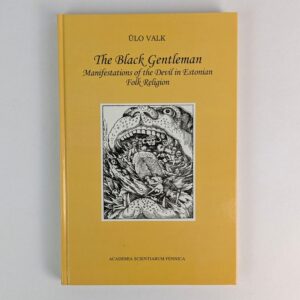
The Black Gentleman: Manifestations of the Devil in Estonian Folk Religion
AU$50 Read MoreAdd to cartUlo Valk
Helskinki: Suomalainen Tiedeakatemia, 2000.This empirical study of the Devil in the collections of the Estonian Folklore Archives, reflecting the world of belief inhabited by the Estonians in the 19th and 20th centuries, is also a book about suspicion and fear in everyday life. It describes how religious folklore has drawn borders between the human and the non-human, how it has modelled the Other, the supernatural and social evil. As a study of folk narrative, and legends in particular, it mainly discusses variation at the level of motif with special reference to the visual guises of the Devil. FF Communications No. 276 published by the Finnish Academy of Science and Letters.
-
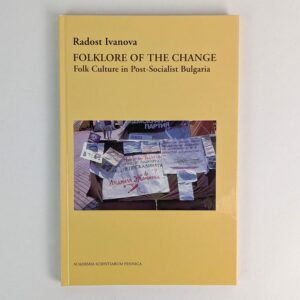
Folklore of the Change: Folk Culture in Post-Socialist Bulgaria
AU$40 Read MoreAdd to cartRadost Ivanova
Helskinki: Suomalainen Tiedeakatemia, 1999.The book analyses the developments taking place in Bulgaria in the years following November 10, 1989. The dynamics of the political and socio-economic changes in that period are comparable only to the most extreme periods of Bulgaria’s history. This study is not a political analysis. It is an attempt to follow the changes in people’s mentality. This book documents the enthusiasm of the negation of a chimera lasting half a century and the euphoria of the search for new roads. The volume consists of eight studies, seven of which deal with the democratic processes and developments in Sofia. FF Communications No. 270 published by the Finnish Academy of Science and Letters.
-
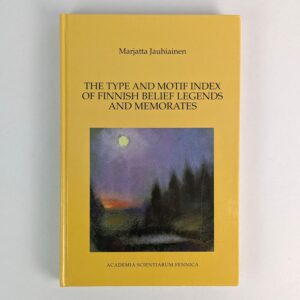
The Type and Motif Index of Finnish Belief Legends and Memorates
AU$65 Read MoreAdd to cartMarjatta Jauhiainen
Helskinki: Suomalainen Tiedeakatemia, 1998.Lauri Simonsuuri’s Typen- und Motivverzeichnis der finnischen mythischen Sagen (FFC 182), published in 1961 and reprinted in 1987, became a classic among the national legend catalogues. Marjatta Jauhiainen’s work not only updates and brings into English the catalogue, it is a thorough revision and enlargement of the classification system itself. In the introduction she surveys the history of collecting and the progress of belief-legend cataloguing on the international scene providing a concordance with Reidar Th. Christiansen’s The Migratory Legends (FFC 175, 1958/1992). A clarification of key terms, a subject directory and a map displaying tradition areas in Finland help the reader to orientate in the exceptionally rich store of belief legends and memorates. FF Communications No. 267 published by the Finnish Academy of Science and Letters.
-
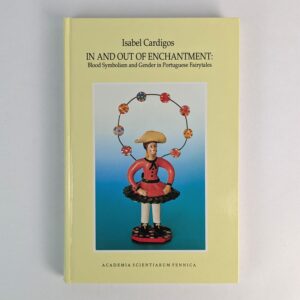
In and Out of Enchantment: Blood Symbolism and Gender in Portuguese Fairytales
AU$60 Read MoreAdd to cartIsabel Cardigos
Helskinki: Suomalainen Tiedeakatemia, 1996.The core of fairytales is the realm of enchantment. This study argues that the bloodshed associated with menstruation, defloration and childbirth–natural episodes in the lifecycle of women–is central to a syntax of enchantment and disenchantment that is common to all fairytales. It is a reflection on the gendered voices that have generated and contributed to the structure and symbolism of fairytales; and it takes shape along with the discussion of Portuguese versions of wide-spread tale types like AT303 (The Two Brothers), AT313 (The Girl as Helper in the Hero’s Flight and AT516 (Faithful John), as well as through an intriguing ecotype of Snake Helper tales (AT533*), ‘The Little Snake’. FF Communications No. 260 published by the Finnish Academy of Science and Letters.
-
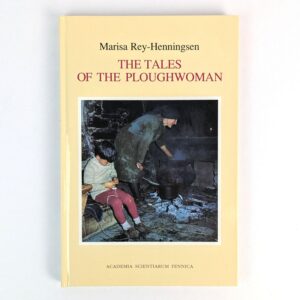
The Tales of the Ploughwoman
AU$40 Read MoreAdd to cartMarisa Rey-Henningsen
Helskinki: Suomalainen Tiedeakatemia, 1996.Appendix to FFC 254. FF Communications No. 259 published by the Finnish Academy of Science and Letters.
-
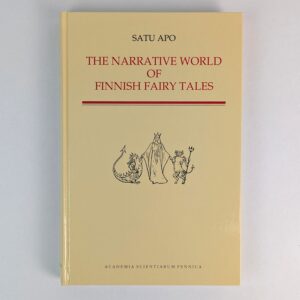
The Narrative World of Finnish Fairy Tales
AU$60 Read MoreAdd to cartSatu Apo
Helskinki: Suomalainen Tiedeakatemia, 1995.Finnish fairy tales represent the northern branch of the Western European fairy-tale tradition. Although Finnish epic folklore and mythology have been objects of great research interest, Finnish fairy tales have been studied surprisingly little. This study answers not only methodological but also the most important empirical questions, such as: what are the themes, plots and characters which have been able to entertain both fairy-tale tellers and their listeners from one generation to the next? How can these contentual elements be understood and interpreted within the framework of traditional Finnish folk culture? /// The methodological issues dealt with here include the question of how to approach traditional folklore material recorded in the 1800s, of which there is an enormous amount but very little accompanying contextual information. In order to analyse the contents of the tales, this study suggests the use of several semantic levels of abstraction as well as the systematic analysis of variation; only then is it feasible to present macrocontextual, interpretive hypotheses in which narrative and cultural structures are examined side by side. FF Communications No. 256 published by the Finnish Academy of Science and Letters.
-
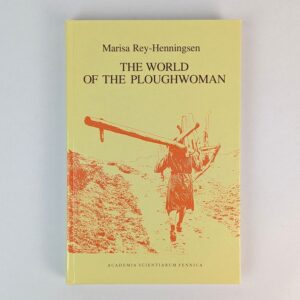
The World of the Ploughwoman: Folklore and Reality in Matriarchal Northwest Spain
AU$60 Read MoreAdd to cartMarisa Rey-Henningsen
Helskinki: Suomalainen Tiedeakatemia, 1993.This study is a contribution to the discussion of folklore as a mirror of society. Spanish Galicia offers a special opportunity for examining wellknown folktales in a different context because of the cultural and economic dominance of women and the matriarchal life style which characterized the region until recently. That matriarchy was deeprooted in Galicia and did not result from male migration in modern times, is demonstrated in the historical chapters of the book, while the anthropological chapters (on family systems, work patterns, matriarchal ideology, sexual behaviour, religion and magic) tend to show that all aspects of Galician culture have been “canonized” in folklore; folklore therefore must have gone through radical changes in order to conform with the local ideology. While the women in Galician folktales almost always appear in active and aggressive hero roles, this has nothing to do with “wishful thinking” or “poetic fiction”, for according to the matriarchal concept it is just the natural order of things. Surely the correlation demonstrated here between the social structure, gender roles, and ideology may also be observed in male-dominated societies, once we learn to disengage from the patriarchal concept of the “natural order of things”. FF Communications No. 254 published by the Finnish Academy of Science and Letters.
-
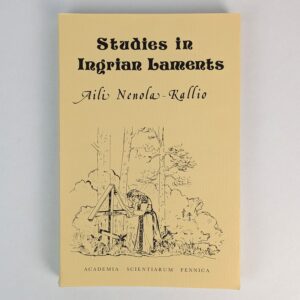
Studies in Ingrian Laments
AU$40 Read MoreAdd to cartAili Nenola-Kallio
Helsinki: Suomalainen Tiedeakatemia, 1982.Collection and analysis of Ingrian lament traditions, exploring ritual expression, grief, and regional folk poetics. FF Communications No. 234 published by the Finnish Academy of Science and Letters.
-
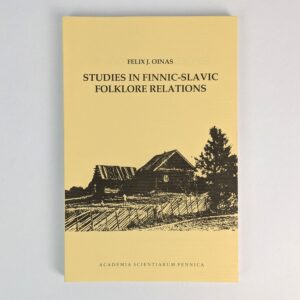
Studies in Finnic-Slavic Folklore Relations
AU$30 Read MoreAdd to cartFelix J. Oinas
Helsinki: Suomalainen Tiedeakatemia, 1991.Comparative study of Finnic and Slavic folklore, examining shared motifs, narrative structures, and cultural exchanges. FF Communications No. 205 published by the Finnish Academy of Science and Letters.
-
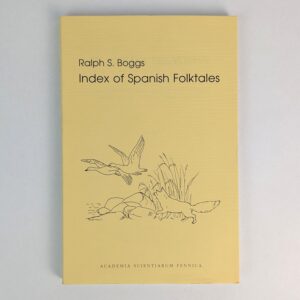
Index of Spanish Folktales
AU$30 Read MoreAdd to cartRalph S. Boggs
Helsinki: Suomalainen Tiedeakatemia, 1993.Classified according to Antti Aarne’s types of the folktale, translated and enlarged by Stith Thompson, in FF Communicatoins No. 74. FF Communications No. 90 published by the Finnish Academy of Science and Letters.
-
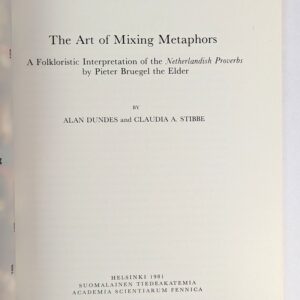
The Art of Mixing Metaphors: A Folkloristic Interpretation of the Netherlandish Proverbs by Pieter Bruegel the Elder
AU$30 Read MoreAdd to cartAlan Dundes; Claudia A. Stibbe
Helsinki: Suomalainen Tiedeakatemia, 1981.FF Communications No. 230 published by the Finnish Academy of Science and Letters.
-
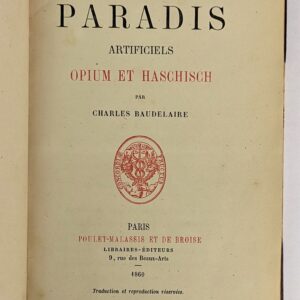
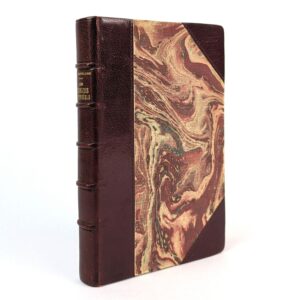
Les Paradis Artificiels: Opium et Haschisch
AU$4,000 Read MoreAdd to cartCharles Baudelaire
Paris: Poulet-Malassis et de Broise, 1860.First edition of Baudelaire’s Artificial Paradises, on the drug experiences of hashish and opium and their relationship with creative expression, being accounts from within the walls of Le Club des Haschischins and a translation and adaptation of Thomas De Quincey’s Confessions of an English Opium-Eater. CARTERET I:126. This copy rebound in a fine half leather binding without the wrappers.
-
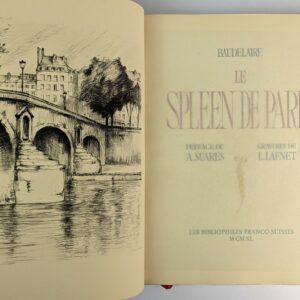
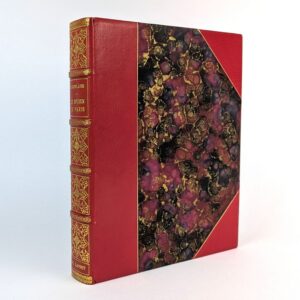
Le Spleen de Paris
AU$1,400 Read MoreAdd to cartCharles Baudelaire; L. Lafnet
: Les Bibliophiles Franco-Suisses, 1940 [1941].One of 106 numbered copies reserved for members of the final illustrated book by Luc Lafnet, with 90 etchings each with tissue guard.
-
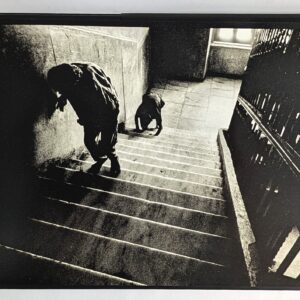
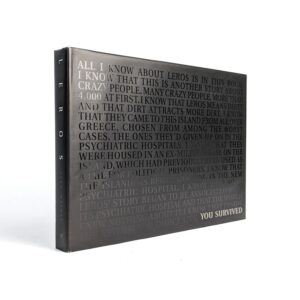
Leros
AU$300 Read MoreAdd to cartAlex Majoli
London: Trolley, 2002.Debut photo book by Magnum photographer Alex Majoli documenting the psychiatric hospital on the Greek island of Leros.
-
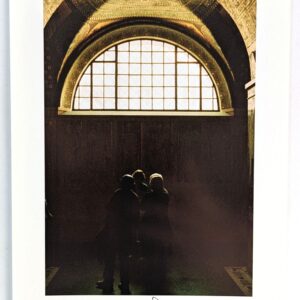
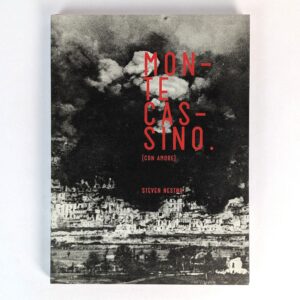
Monte Cassino (Con Amore) w/ Print
AU$40 Read MoreAdd to cartSteven Nestor
Sydney: T&G Publishing, 2019.“Monte Cassino: Con Amore is an exploration by Steven Nestor of the destruction of a small Italian town Monte Cassino and its monastery in the Second World War. Surviving copies of The Illustrated London News from 1944 lead Nestor on a journey to discover and record the last remaining traces of the devastation of the town and the Benedictine monastery built on the site of the original Abbey chosen and founded by St Benedict in the 6th century. Blending original material from his research archive alongside his own images, Nestor encourages the viewer to cross into an elusive but violent past. The photographic windows throughout this book look out onto a buried past that continues to inform and shape our present through the fragments that have survived destruction, the passage of time and a human quest to overcome disaster. This is a journey across unremarkable contemporary places and into their dark history: forlorn graffiti semaphores in a space once littered with casualties of battle, a collapsed street sign lies unnoticed on the edge of town and autumns mulch burns on the road that snakes its way up to the summit of worship and war.” (publisher’s blurb) This copy signed by Nestor on the title page and with a signed photographic print in a paper folder laid in.
-
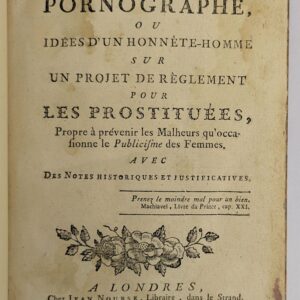
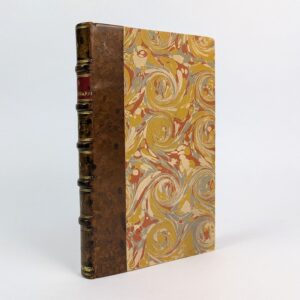
Le Pornographe, ou Idees d’un Honnete-Homme sur, un Projet de Reglement pour les Prostitutes,
AU$1,000 Read MoreAdd to cart[Nicolas Restif de La Bretonne]
Londres and La Haie: Jean Nourse and Gosse Junior, 1770.Propre a prevenir les Malheurs qu’occafionne le Publicisme des Femmes. Avec Des Notes Historiques et Justificatives. [The Pornographer, or Ideas of an Honest Man on a Draft Regulation for Prostitutes, Proper to Prevent the Misfortunes Occurring from the Publicity of Women. With Historical and Justificatory Notes]. Second Edition of the classic 18th century utopian text on sex work in which Bretonne envisions prostitution as a public institution with numerous social and medical benefits. This copy in a 20th century rebind in quarter leather with new endpapers, and extra-illustrated with one erotic illustration bound in at page 16.
-
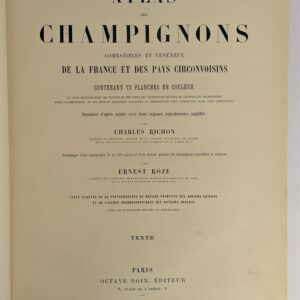
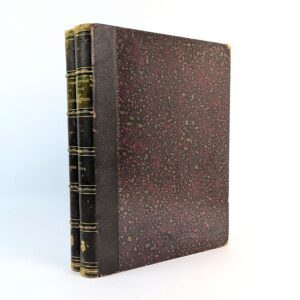
Atlas des Champignons Comestibles et Veneneux de la France et des pays Circonvoisins
AU$2,500 Read MoreAdd to cartCharles Richon; Ernest Roze
Paris: Octave Doin, 1888.Atlas of edible and poisonous mushrooms of France and surrounding countries containing 72 color plates or figures of 229 types of the main species of mushrooms sought for food, and similar suspect or dangerous species with which they are confused drawn from nature with their reproductive organs amplified by Charles Richon… Accompanied by a monograph of these 229 species and a general history of edible and poisonous mushrooms by Ernest Roze… Text illustrated with 62 photoengravings of primitive drawings by old authors and organographic figures by recent authors after reproductions made by Charles Rolet. Key late 19th century work of French mycology. VOLBRACHT 1753. BITTING pg. 398. This copy with the bookplate of French mycologist Raymond Bertault.