
Prices in AUD. Free Australian delivery for orders over $400. Free international delivery for orders over $800. Read full terms.
Showing 601–700 of 1096 resultsSorted by latest
-
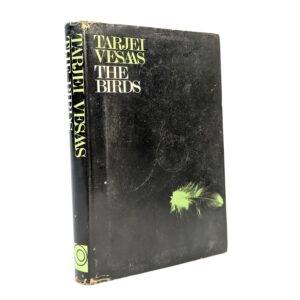
The Birds
AU$150 Read MoreAdd to cartTarjei Vesaas
London: Peter Owen, 1968.Translated from the Norwegian, Fuglane, by Torbjorn Stoverud and Michael Barnes.
-
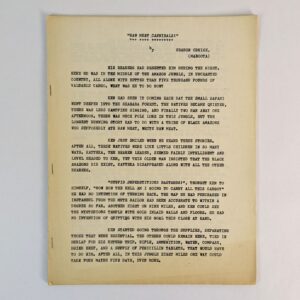
Raw Meat Cannibals!
AU$150 Read MoreAdd to cartSharon Cruise (Maboota)
: Sharon Cruise (Maboota), No date.Duplicated typescript for an unpublished erotic-horror short story based in the Amazon. A man alone in the jungle comes across a tribe of black muscular nude women that torture him and force him to perform sexual acts on them before eating him.
-
![The Magic of Colour [Color] Harmony in Dress](https://www.thebookmerchantjenkins.com/wp-content/uploads/0035254-300x300.jpg)
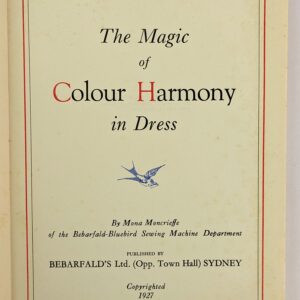
The Magic of Colour [Color] Harmony in Dress
AU$500 Read MoreAdd to cartMona Moncrieffe
Sydney: Bebarfald’s, 1927.1920s ladies’ fashion, though more extensively a guide to succeeding as a crafty and fashionable woman with a particular focus on the successful use of colour for different types of women. The majority of the illustrations signed Hilton, possibly Cecil Hilton Jones, also Alec J. Wood.
-
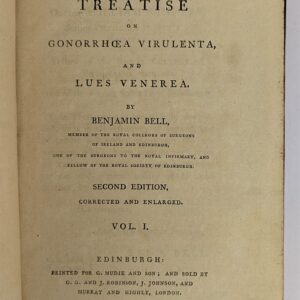
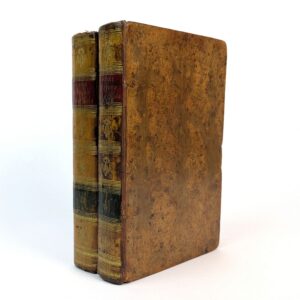
A Treatise on Gonorrhea Virulenta, and Lues Venerea
AU$1,500 Read MoreAdd to cartBenjamin Bell
Edinburgh: G. Mudie and Son, 1797.Primarily regarded as surgeon, Bell is considered to be the first Scottish scientific surgeon. His scientific approach is especially evident in this treatise in which he convincingly argues, against the prevailing medical opinion of the time, that gonorrhea and syphilis are separate diseases. Bell’s work is foundational to the modern understanding of sexually transmitted infections (STIs). The rare Second Edition, corrected and enlarged.
-
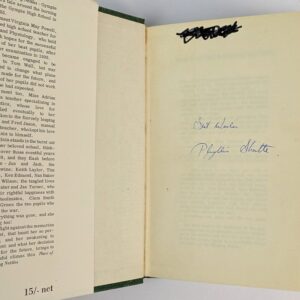
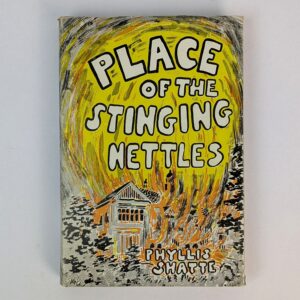
Place of the Stinging Nettles
AU$150 Read MoreAdd to cartPhyllis Shatte
Ilfracombe: Arthur H. Stockwell, 1970.A novel of Gympie, Queensland. This copy signed by the author.
-
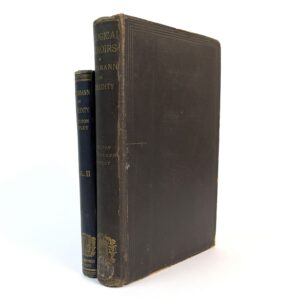
Essays Upon Heredity and Kindred Biological Problems (2 Volumes)
AU$200 Read MoreAdd to cartAugust Weismann
Oxford: at the Clarendon Press, 1889-92.Edited by Edward B. Poulton, Selmar Schonland, and Arthur E. Shipley.
-
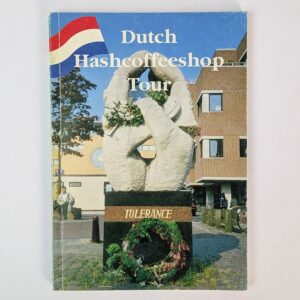
Dutch Hashcoffeeshop Tour
AU$40 Read MoreAdd to cartAnonymous
Breda: Ja Ja Exports, 1995.1990s guide to the coffee shops (marijuana cafes) of Amsterdam (and other Netherlands cities). Very detailed including the author’s review of each shop, as well as information about other cannabis culture. Also touches on the sex culture of the city.
-
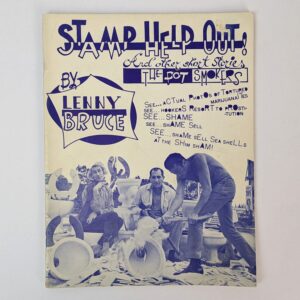
Stamp Help Out! And Other Short Stories: The Pot Smokers
AU$550 Read MoreAdd to cartLenny Bruce
[New York]: [Lenny Bruce], No date.The 1962 self published zine of American comic Lenny Bruce (1925-1966). See… Actual photos of tortured Marijuanaites. See… Hookers Resort to Prostitution. See… Shame. See… Shame Sell. See… Shame Sell Sea Shells at the Shim Sham! The second issue, with the rude words typed over out of fear of persecution.
-
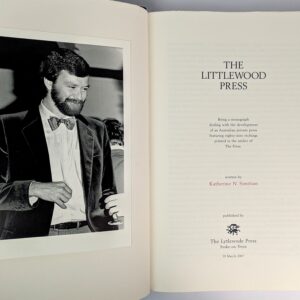
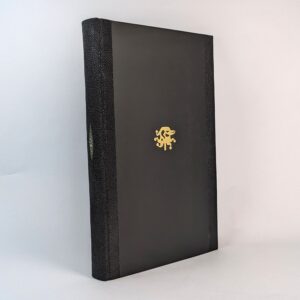
The Littlewood Press
AU$8,000 Read MoreAdd to cartKatherine N. Simitian
Stoke-on-Trent: The Lytlewode Press, 2007.Being a monograph dealing with the development of an Australian private press featuring eighty-nine etchings printed in the atelier of The Press. A short history of the Littlewood Press from 1996 to 2007 featuring original etchings printed at the Press editioned from its published works and commissioned artists including Sir Lionel Lindsay, Norman Lindsay, Derham Groves, Allan Jordan, Trish Hart, Tony Irving, Pro Hart, Andrew Sibley, Caitlin Littlewood, Robbie Harmsworth, Peter Jones, Marc Severin, and Leslie Tarrant. Bound in stingray, likely the first Australian publication using this skin, the natural white star of the skin forming a decorative emblem to the spine. The idea for this book originated in 1996 when the publisher undertook to print ten additional copies of every etching printed at the press with the intention of creating a history volume at a later date. A number of the etchings are ex libris bookplates. One of the finest Australian art publications, limited to just 10 copies, signed and numbered by the author and the publisher, 5 of which are housed in Australian institutions. This copy is number 10 and includes the original prospectus, The History of The Littlewood Press, featuring an additional Trish Hart etching and signed by the publisher, Robert Littlewood. Issued with 81 of the 89 listed etchings, and with 4 of the Pro Hart etchings supplied twice, making for a total of 85 etchings and photographic portrait of the publisher. The plates not included as per the checklist are: 10. Trish Hart: Nesting Gull; 34. Tony Irving: The Old Kiosk [Black]; 37. Tony Irving: Home Alone [Black]; 39. Tony Irving: Ramsen Place; 40. Tony Irving: Drewery Lane; 42. Tony Irving: Hosier Lane; 43. Tony Irving: Waratah Place; 44. Tony Irving: China Town. The four Pro Hart plates that are included in duplicate are: 45. Singers at the Southern Cross Hotel; 46. Miner’s Kids; 47. Yabbie Picnic; 48. Gethsemane. The plates not included do not appear to have been removed, but as in true Private Press fashion, the difference in actual issue to the stated intention differing as per the whim, requirement, or temperament of the publisher.
-
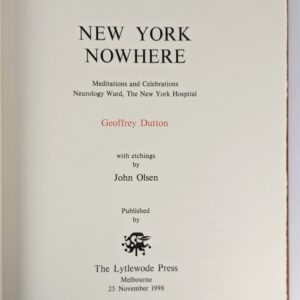
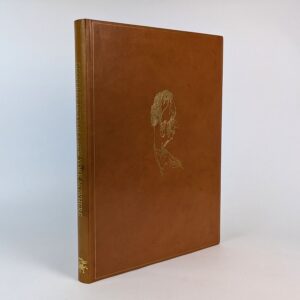
New York Nowhere: Meditations and Celebrations, Neurology Ward, The New York Hospital
AU$6,000 Read MoreAdd to cartGeoffrey Dutton; John Olsen
Melbourne: The Lytlewode Press, 1998.One of 30 deluxe copies from the total edition of 175 numbered copies signed by John Olsen and Robert Littlewood containing ten original signed etchings by John Olsen. The deluxe issue bound in brown kangaroo leather by Friedhelm Pohlmann also contains a tipped in sheet of original manuscript by the poet, ten original photographs of the artist and the poet signed by the publisher, five pieces of typescript correspondence hand signed by the publisher, 2 additional unsigned Olsen etchings, and an envelope containing a CD of Dutton reciting his poem. The recording of the CD made only weeks before Dutton’s death. New York Nowhere was Dutton’s last literary work, reflecting on the poet’s stroke and recovery in a New York hospital. Also included is the original prospectus and The Australian Magazine Dec 12-13, 1998 with the cover story on this work.
-
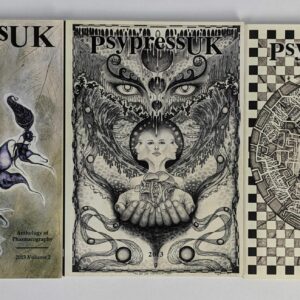
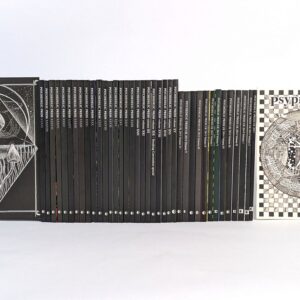
Psychedelic Press (Complete Set, 40 Volumes)
AU$3,000 Read MoreAdd to cartRobert Dickens; Nikki Wyrd
London: Psychedelic Press, 2012-2023.A complete run of the psychedelic studies journal Psychedelic Press, early issues also titled psypressUK, and billed as an Anthology of Pharmacography. Comprising 40 issues published between 2012 and 2023 edited by Robert Dickins and Nikki Wyrd, together containing hundreds of papers on the history, literature, philosophy, and culture of psychoactive plants and substances. Features contributions by Andy Roberts, David Graham Scott, Reverend Nemu, Martin W. Ball, Nikita Petrov, Are Thoresen, David Nickels, Mike Crowley, Ben Sessa, Havelock Ellis, Julian Vayne, LiZ Elliot, Mike Jay, Roger Keen, Henrik Dahl, Thomas Hatsis, James W. Jesso, Ross Heaven, Peter Sjostedt-H, Stanislav Grof, Graham St John, James Oroc, Rick Strassman, and many others.
-
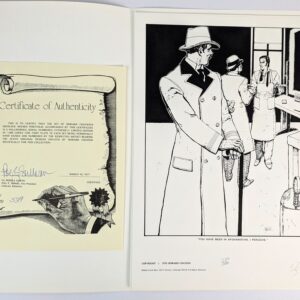
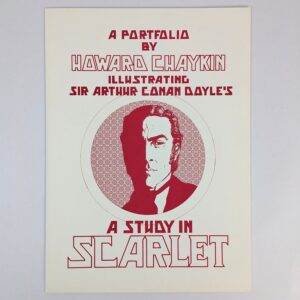
A Portfolio by Howard Chaykin Illustrating Sir Arthur Conan Doyle’s A Study in Scarlet
AU$100 Read MoreAdd to cartHoward Chaykin
Denver: Middle Earth, 1977.Portfolio by American comic book artist Howard Chaykin, the first plate signed and numbered by him and with a COA signed by the publisher. Edition of 1,000 numbered copies.
-
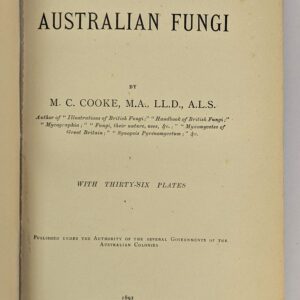
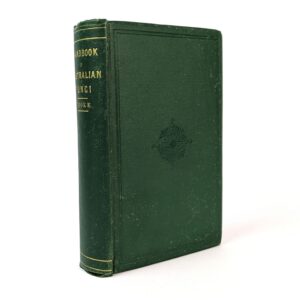
Handbook of Australian Fungi
AU$1,500 Read MoreAdd to cartM. C. Cooke
London: Williams and Norgate for the Departments of Agriculture in Melbourne, Brisbane, Sydney, Adelaide, Hobarton, 1892.The first monograph on Australian fungi by English botanist and mycologist Mordecai Cubitt Cooke (1825-1914). Containing descriptions of 2079 species of macrofungi, microfungi, and slime moulds (or myxomycetes), of which 377 figures are illustrated across 36 plates. The samples which the handbook are based on were supplied by Ferdinand von Muller, Flora Martin, F. M. Bailey, Sven Berggren, and others, and shipped to Cooke in England. This distance limited the accuracy of the work, nevertheless, as the first volume devoted to the subject its historical import cannot be understated and remains a key work in any Australian mushroom collection.
-
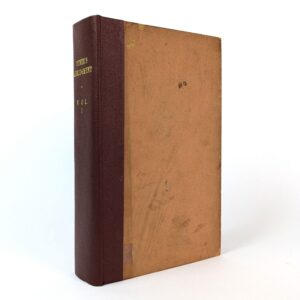
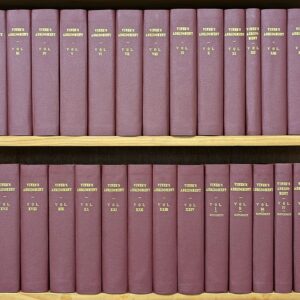
A General Abridgment of Law and Equity (30 Volumes)
AU$5,500 Read MoreAdd to cartCharles Viner
London and Dublin: Printed for G. G. J. and J. Robinson, T. Payment, E. and R. Brooke, T. Whieldon and J. Butterworth; and L. White, 1791-1806.Second Edition of Viner’s monumental digest of English law, together with the six volume supplement, An Abridgment of the Modern Determinations in the Courts of Law and Equity. (London: A. Strahan, 1799-1806). The work is alphabetically arranged under subject headings, with extensive notes and references throughout. This edition comprises the twenty-four-volume second edition of the General Abridgment and the complete six-volume supplement, issued over a period of fifteen years. The English jurist Charles Viner (1678-1756) devoted much of his life to the compilation of this vast legal encyclopaedia, an undertaking ultimately derived from Rolle’s Abridgment but greatly expanded in scope. Drawing upon reported cases, manuscript authorities, statutes, and earlier legal compilations, it became one of the principal reference works of the common law tradition. J. G. Marvin described it as “the most voluminous production of any single individual in the whole bibliography of the Common Law”, nothing that Viner had “translated, abridged, remodelled” and incorporated material from the older abridgments and reports. A substantial and influential legal reference work, forming one of the foundations of eighteenth-century English legal scholarship.
-
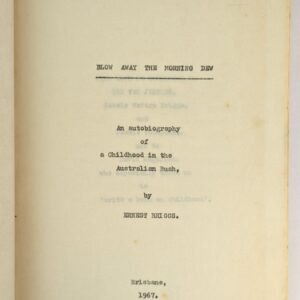
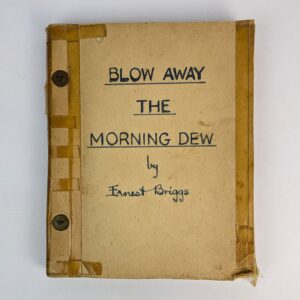
Blow Away the Morning Dew: An Autobiography of a Childhood in the Australian Bush
AU$550 Read MoreAdd to cartErnest Briggs
Brisbane: Ernest Briggs, 1967.The unpublished childhood memoir of Australian poet, broadcaster, and critic Ernest Briggs (1905-1967), prepared in Brisbane in 1967, the year of his death from myocardial infarction. The typescript offers a vivid first-hand account of early 20th-century life in rural New South Wales, particularly around Marsden Park and Riverstone, then bush settlements on Sydney’s north-western fringe. Laced with his verse and literary flourishes, Briggs recalls his early years in a cottage at Marsden Park, the death of his mother when he was three, and the following three years spent at the Ashfield Infants’ Home under the care of Matron Rebecca Marston. Returning home at six, a frail child excused from school by doctor’s order, he spent his days in his father’s bootmaking workshop at Riverstone or exploring the surrounding bush. Family reminiscences extend further back: his father’s recollections of childhood in Ballarat and Clunes, Victoria, and colonial family correspondence from the early to mid-nineteenth century, marking Briggs as a fifth-generation Australian. The memoir also recounts his reluctant return to schooling, the regular corporal punishment, and his growing sense of creative independence. Domestic scenes reveal the artistic atmosphere that shaped his imagination: “Once when a visitor had said, ‘Quite an art-showing you’ve got here, Charlie,’ my father walked around the room saying, ‘It comes of mixing with artists in my younger days … This is a Burket-Foster; here are a couple by the noted water-colourist Miss Allingham … this is by Uncle Tom Roberts, the first man in Australia to paint extensive oils…” Briggs also recalls excursions with his father into Sydney on public holidays, evocative tours of the city’s landmarks and recollections of its colonial past, as well as chance encounters with actress Nellie Stewart and, later, Dame Nellie Melba during his brief employment as a messenger-boy, moments that helped form his artistic sensibility. Other recollections include trips to Campbelltown, Windsor, Richmond, and Camperdown Cemetery, each described with a historian’s eye and a poet’s nostalgia. A richly detailed and intimate account of childhood, environment, and creative formation, this unpublished typescript provides valuable insight into Briggs’s literary development and into everyday colonial heritage in early twentieth-century New South Wales.
-
French Masculinities: History, Culture and Politics
AU$100 Read MoreAdd to cartChristopher E. Forth; Bertrand Taithe
Basingstoke and New York: Palgrave Macmillan, 2007.This copy inscribed by Christopher Forth
-
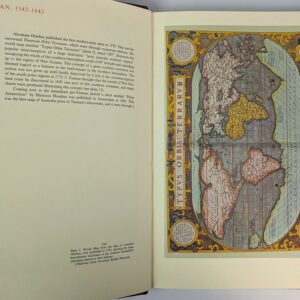
Early Charts of New Zealand, 1542-1851
AU$600 Read MoreAdd to cartPeter Bromley Maling
Wellington: A. H. & A. W. Reed, 1969.Maps detailing New Zealand from 1542 to 1851. Limited to 500 numbered copies, of which this is number 238.
-
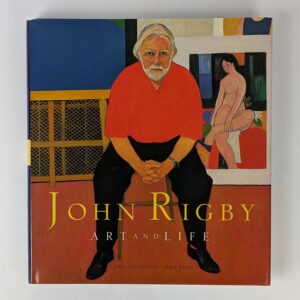
John Rigby: Art and Life
AU$80 Read MoreAdd to cartJohn Millington; Mark Rigby
Sydney: Playright Publishing, 2003. -
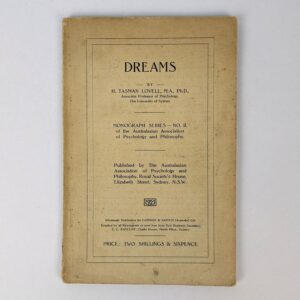
Dreams
AU$50 Read MoreAdd to cartH. Tasman Lovell
Sydney: The Australasian Association of Psychology and Philosophy, 1923.The Australasian Association of Psychology and Philosophy Monograph Series No. II. This copy with the ownership stamp of K. Thompson Matthews, interleaved with numerous blanks, copiously underlined and with some marginalia.
-
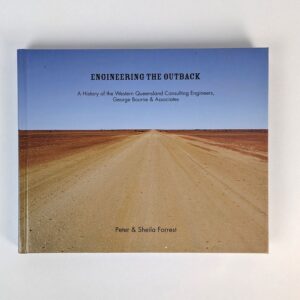
Engineering The Outback: A History of the Western Queensland Consulting Engineers, George Bourne & Associates
AU$55 Read MoreAdd to cartPeter Forrest; Sheila Forrest
Barcaldine: George Bourne and Associates, 2006. -
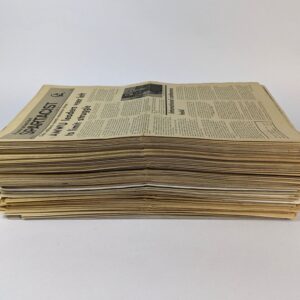
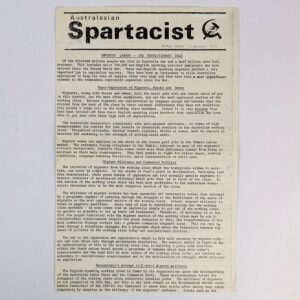
Australasian Spartacist (No. 1 – 212, 1973-2011)
AU$1,500 Read MoreAdd to cartSpartacist League of Australia and New Zealand
Sydney and Melbourne: Spartacist League of Australia and New Zealand, 1973-2011.A significant unbroken run of Australasian Spartacist: Organ of Revolutionary Marxism for the Rebirth of the Fourth International, from No. 1, 1973, through to No. 212, 1986. Nos. 1 through 5 were published as mimeographed copies (and here an original mimeograph of No. 3 together with 2 additional copies in facsimile, and with Nos. 1, 2, 4, and 5 supplied as facsimiles in triplicate and also including the B versions of Nos. 2 and 5), the rest (6-212) as original tabloid newsprint (except No. 125 and 136 supplied in facsimile). Also included is an original duplicate of No 143, and the original supplements for 7 June 1975, 2 July 1975, 24 June 1977, 1 February 1980, 8 September 1989 (2 copies), 2 September 1991, 2 June 1993, December 1999, and November 2001, and A Spartacist Pamphlet: For a Workers Republic of Australia, Part of a Socialist Asia! (Sydney: Spartacist ANZ Publishing Co., 1998). In total Australasian Spartacist ran until No 240, 2020, and in 2024 has re-emerged as Red Battler: Newspaper of the Spartacist League of Australia with 1 issue published to date.
-

Cannabinoids as Therapeutic Agents
AU$500 Read MoreAdd to cartRaphael Mechoulam
Boca Raton: CRC Press, 1986.A summary of past and present therapeutic uses and research of cannabis sativa. Contributors include Paul Consroe, Stuart R. Snider, Martin W. Adler, Ellen B. Geller, Martin Levitt, Robert A. Archer, Paul Stark, Louis Lemberger, Mark Segal, M. Ross Johnson, Lawrence S. Melvin, and James D. P. Graham. Edited by Raphael Mechoulam (1930-), an Israeli chemist known for the first isolation and synthesis of tetrahydrocannabinol (THC), the principal psychoactive in marijuana.
-
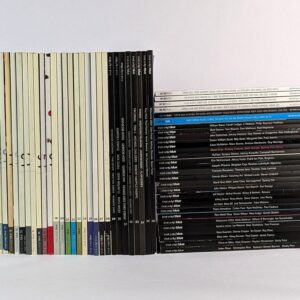
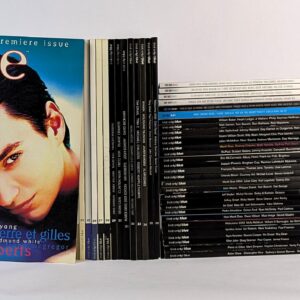
(not only) Blue (Complete Set, 67 Volumes)
AU$2,200 Read MoreAdd to cartMarcello Grand
Sydney: Studio Magazines, 1995-2007.A complete set of Australian gay men’s magazine, (not only) Blue, from issue 00 to 66 (67 total). Blue was a glossy coffee table art magazine produced between 1995 and 2007 by Studio Magazines in Sydney, publishers of the successful photography magazine, Black+White. “Blue’s agenda is to showcase artists whose work is an authentic representation of gay relationships, gay lifestyles and gay issues” (Blue’s editorial statement) and it did so in a large format filled with nude and semi nude art photography. The premiere issue featured William Yang, Tom Bianchi, Pierre et Gilles, Edmund White, Fiona McGregor, and Ian Roberts, and over its 12 year history featured work from top photographers and features on artists and celebrities including Robert Mapplethorpe, Leigh Bowery, Boy George, Erwin Olaf, k.d. lang, Bruce of LA, Dennis Rodman, Elton John, John Waters, Karl Lagerfield, Jeffrey Smart, Yukio Mishima, Paul Cadmas, William S. Burroughs, George Platt Lynes, Gilbert and George, Rupert Everett, Uma Thurman, Wilhelm von Gloeden, and countless others.
-
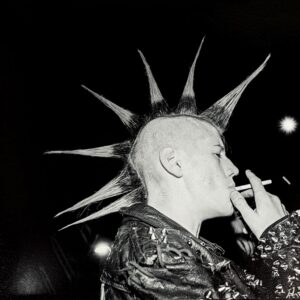
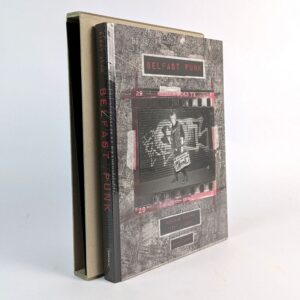
Belfast Punk: Warzone Centre, 1997 – 2003 (Deluxe Edition)
AU$650 Read MoreAdd to cartRicky Adam
Bologna: Damiani Editore, 2017.The deluxe edition, limited to 15 copies, with an original signed and numbered photograph by Ricky Adam. “The Warzone Collective began in 1984 in Belfast, Northern Ireland, when a few local punks decided to consolidate their efforts and find their own venue, practice, and social space. In 1986, the Collective opened Giros, its first premises in Belfast, which contained a vegetarian cafe, practice space, and screen printing facilities. It soon became a focal point for anarchists and punks. In 1991 the Collective moved Giros to a larger and more ambitious venue, the spot where all of the photographs in this book were taken. Over the years, thousands of people passed through Giros’ doors. A strong D.I.Y. ethic defined the way gigs and events were organized. It didn’t have an alcohol license, and it was an all ages venue. The Warzone Centre, or The Centre as it was called by some, became the countercultural hub for the greater Belfast area and beyond. Bands from all over the world played there, and it was famous for being one of the best in Europe for D.I.Y. punk. The photographs in this book were taken between 1997 and 2003. Toward the end of 2003, the Centre closed, leaving a huge gap in radical Belfast culture. It reopened in 2011, in a different venue on the opposite side of town and is still going strong today.” (publisher’s blurb)
-
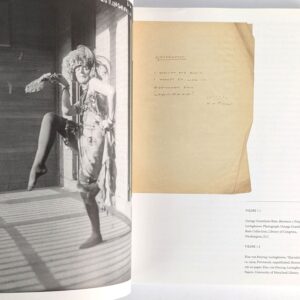
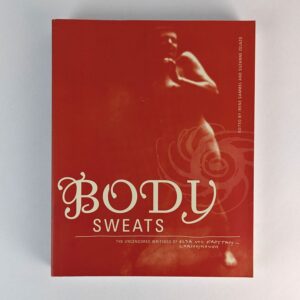
Body Sweats: The Uncensored Writings of Elsa Von Freytag-Loringhoven
AU$100 Read MoreAdd to cartElsa von Freytag-Loringhoven; Irene Gammel; Suzanne Zelazo
Cambridge: MIT Press, 2011.The Uncensored Writings of Elsa Von Freytag-Loringhoven edited by Irene Gammel and Suzanne Zelazo. The first major published poetry collection of German-born artist and poet, active in New York from 1913 to 1923.
-
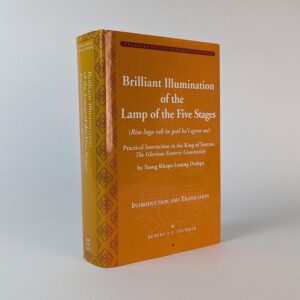
Brilliant Illumination of the Lamp of the Five Stages
AU$100 Read MoreAdd to cartRobert A. F. Thurman
New York: The American Institute of Buddhist Studies, Columbia University Center for Buddhist Studies, 2010.(Rim Ing rab tu gsal ba ‘i sgron me) Practical Instruction in the King of Tantras, The Glorious Khapa Losang Drakpa. Introduction and Translation by Robert A. F. Thurman. Edited by Thomas F. Yarnall. Treasury of the Buddhist Sciences series. Tengyur Translation Initiative. Jey Yabsey Sungbum Collection.
-
Tristan and Isolt: A Study of the Sources of the Romance (2 Volumes)
AU$100 Read MoreAdd to cartGertrude Schoepperle Loomis
New York: Burt Franklin, 1963. -
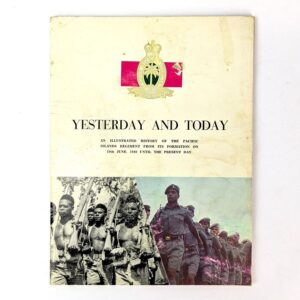
Yesterday and Today: An Illustrated History of the Pacific Islands Regiment
AU$50 Read MoreAdd to cartN. E. W. Granter
Port Moresby: South Pacific Post, 1970.From Its Formation on 19th June, 1940 Until the Present Day.
-
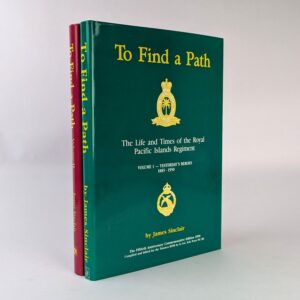
To Find a Path (2 Volumes)
AU$120 Read MoreAdd to cartJames Sinclair
Brisbane and Bathurst: Boolarong Press and Crawford House Press, 1990-1992. -
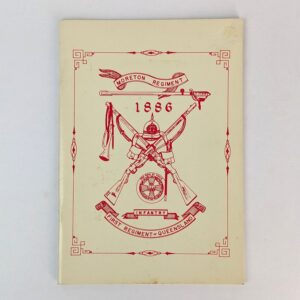
B Company 1st Regiment of Queensland Infantry (Moreton Regiment)
AU$50 Read MoreAdd to cartPeter D. Anderson
Brisbane: Peter D. Anderson, 1986.Cover title: Moreton Regiment, 1886, Infantry, First Regiment of Queensland. A brief history to the Defence of Queensland from 1859, leading up to the formation of the First Regiment of Queensland Infantry sometimes called the Moretons, 1885.
-
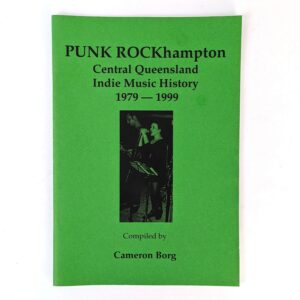
PUNK ROCKhampton: Central Queensland Indie Music History, 1979-1999
AU$40 Read MoreAdd to cartCameron Borg
Bendigo: Moonlight Publishing, 2000. -
Memoirs and Reminiscences of the Late Prof. George Bush
AU$100 Read MoreAdd to cartGeorge Bush; Woodbury M. Fernald
Boston: Otis Clapp, 1860.Being, for the Most Part, Voluntary Contributions from Different Friends, Who Have Kindly Consented to this Memorial of His Worth.
-
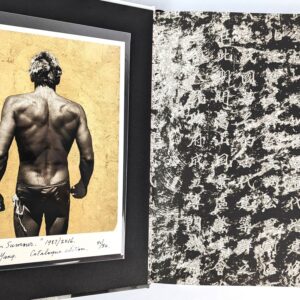
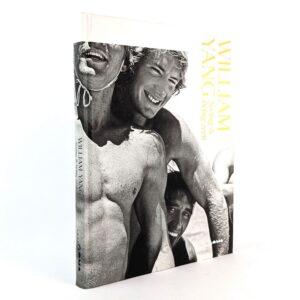
Seeing & Being Seen
AU$600 Read MoreAdd to cartWilliam Yang
Brisbane: Queensland Art Gallery / Gallery of Modern Art, 2021.The deluxe edition, limited to only 50 copies signed by the artist with a limited edition archival inkjet print Golden Summer 1987 / 2016 by William Yang, printed on Hahnemuhle Smooth Cotton Rag paper. The print is signed, titled, dated and editioned by the artist in ink, and mounted inside the upper board in a mylar sleeve housing. “William Yang: Seeing and Being Seen explores photographer and performer William Yang’s five decades of prolific art practice. This is the first major survey exhibition and publication on the artist by a state gallery. Featuring reproductions of over 200 photographs, it traces Yang’s career from his heady early days as a social photographer in the 1970s documenting Sydney’s queer scene through to some of his well-known series addressing family ties, sexual and cultural identity, and the Australian landscape. Developed in collaboration with the artist, the publication also examines the artist’s deep connections to Queensland, including his mid-career explorations of growing up in the far north of the state.” (publisher’s blurb)
-
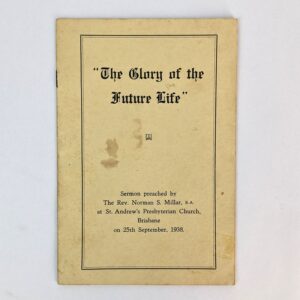
The Glory of the Future Life
AU$40 Read MoreAdd to cartNorman S. Millar
Brisbane: Committee of the Norman Millar Memorial Fund, 1938.Sermon preached by The Rev. Norman S. Millar, B.A. at St. Andrew’s Presbyterian Church, Brisbane on 25th September, 1938.
-
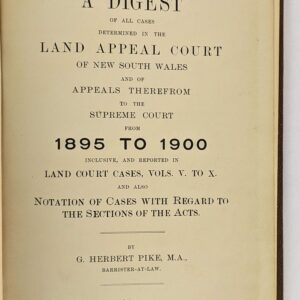
A Digest of All Cases Determined in the Land Appeal Court of New South Wales and of Appeals Therefrom to the Supreme Court from 1895 to 1900
AU$65 Read MoreAdd to cartG. Herbert Pike
Sydney: C. F. Maxwell (Hayes Bros.), 1901.Inclusive, and Reported in Land Court Cases, Vols. V. to X. and also Notation of Cases with Regard to the Sections of the Acts.
-
Huichol Indian Sacred Rituals
AU$120 Read MoreAdd to cartMariano Valadez; Susana Valadez
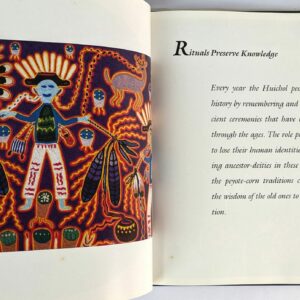
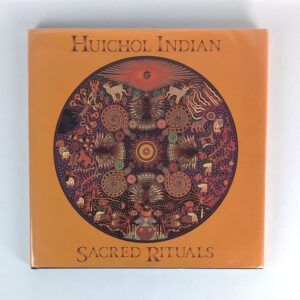
Oakland: Amber Lotus, 1992.Monograph of the peyote inspired paintings of the Huichol Indians. “The sacred ways of the Huichol Indians are vividly communicated in traditional art works called “yarn paintings”. Their symbols represent natural forces that are normally invisible, as well as shamanic ceremonies performed by the Huichol to contact, learn from, and work with these energies.” (from jacket blurb)
-
Ikuntji: Paintings from Haasts Bluff, 1992 – 1994
AU$30 Read MoreAdd to cartMarina Strocchi
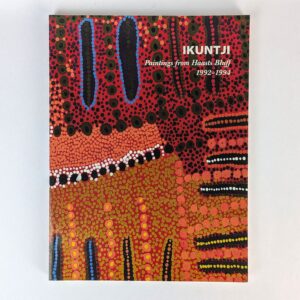
Alice Springs: IAD Press, 1995. -
Mustafa Kemal Araturk
AU$100 Read MoreAdd to cartIlhan Aksit
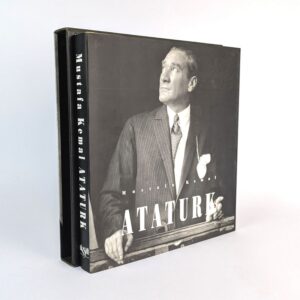
Istanbul: Aksit, No date.Thoroughly illustrated biography of the founding father of the Republic of Turkiye.
-
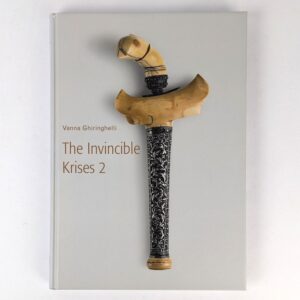
The Invincible Krises 2
AU$100 Read MoreAdd to cartVanna Ghiringhelli
Vercelli: Saviolo Publisher, 2007. -
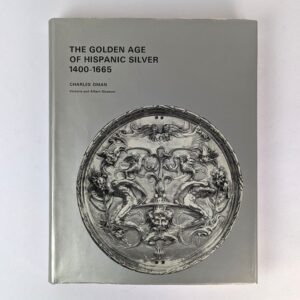
The Golden Age of Hispanic Silver, 1400-1665
AU$100 Read MoreAdd to cartCharles Oman
London: Her Majesty’s Stationery Office, 1968.In original Victoria and Albert Museum carton.
-
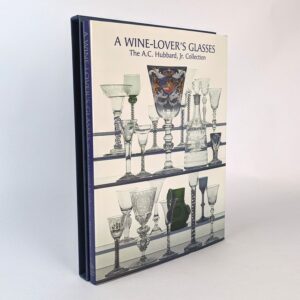
A Wine-Lover’s Glasses: The A.C. Hubbard, Jr. Collection
AU$60 Read MoreAdd to cartWard Lloyd
Shepton Beauchamp: Richard Dennis, 2000. -
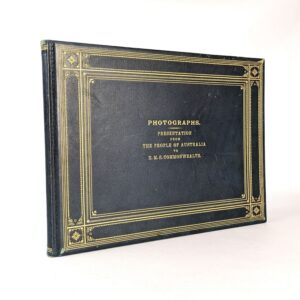
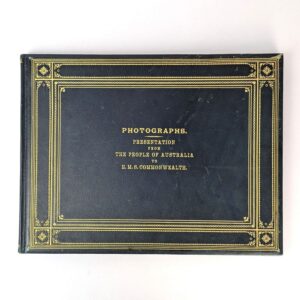
Photographs. Presentation from the People of Australia to H.M.S. Commonwealth
AU$1,000 Read MoreAdd to cartSouth Australian Government Photolithographic Department
[Adelaide]: South Australian Government Photolithographic Department, No date.4 photographs mounted in a full leather presentation album showing a silver challenge shield and silver plate table piece of a model of Captain Cook’s ship, the Endeavour, which was gifted from The People of Australia to HMS Commonwealth, a King Edward VII-class battleship of the British Royal Navy at a naval review in 1911. The album contains the bookplate of lawyer, politician, and Federalist, Sir Josiah Henry Symon (1846-1934). Symon represented the Commonwealth Government at the review and made the presentation of the shield and table piece. Photographs by the S. A. Govt. Photolithographic Dept, A. Vaughan, Govt. Photolithographer. From the collection of J. B. Hawkins.
-
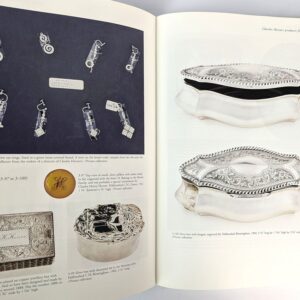
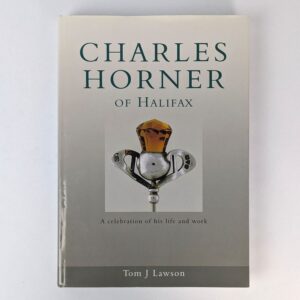
Charles Horner of Halifax: A Celebration of His Life and Work
AU$150 Read MoreAdd to cartTom J. Lawson
Leicester: GML Publishing, 2002. -
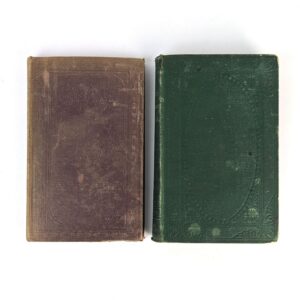
![Vestiges of the Natural History of Creation [AND] Explanations: A Sequel to (2 Volumes)](https://www.thebookmerchantjenkins.com/wp-content/uploads/0034603-300x300.jpg)
Vestiges of the Natural History of Creation [AND] Explanations: A Sequel to (2 Volumes)
AU$2,000 Read MoreAdd to cart[Robert Chambers]
London: John Churchill, 1846-1860.Vestiges, published anonymously, had an enormous influence on Charles Darwin, first published in 1844 and here greatly enlarged. This edition (the second to be illustrated) was published just following the publication of Darwin’s Origin and is Chambers; final revision of the text. A twelfth edition, published in 1884 following Chambers’ death, reprints this text and acknowledges his authorship. // Chambers had planned to respond to criticisms of his work by publishing a series of letters to the ‘Times’ followed by a pamphlet of a hundred or so pages, however Churchill convinced the anonymous author (through his friend Alexander Ireland) that it should be issued in book form, printed and bound similarly to the original. Explanations was duly issued in 1845, and was followed by this slightly altered version in 1846. By then the fifth edition of ‘Vestiges’ was ready and the two works were often reviewed together, the publisher going so far as to suggest a combined volume, however his anonymous author pointed out that the arguments were already incorporated in the new edition.
-
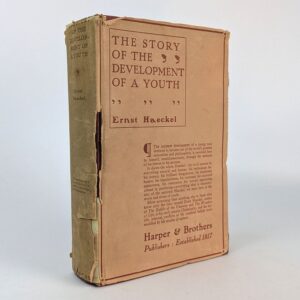
The Story of the Development of a Youth
AU$50 Read MoreAdd to cartErnst Haeckel
New York and London: Harper & Brothers, 1923.Letters to his Parents, 1852-1856. Translated by G. Barry Gifford.
-
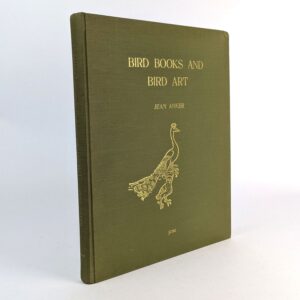
Bird Books and Bird Art
AU$80 Read MoreAdd to cartJean Anker
The Hague: Dr. W. Junk B. V., Publishers, 1973. -
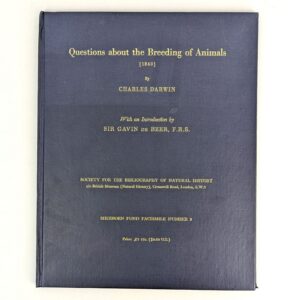
Questions About the Breeding of Animals
AU$40 Read MoreAdd to cartCharles Darwin
London: Society for the Bibliography of Natural History, 1968. -
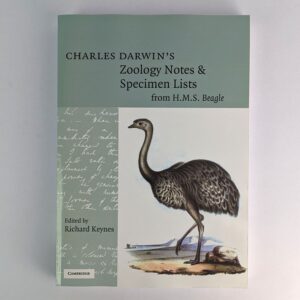
Charles Darwin’s Zoology Notes & Specimen Lists from H.M.S. Beagle
AU$80 Read MoreAdd to cartCharles Darwin; Richard Keynes
Cambridge: Cambridge University Press, 2005. -
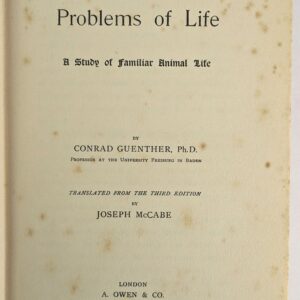
Darwinism and the Problems of Life
AU$40 Read MoreAdd to cartConrad Guenther
London: A. Owen & Co., 1906.The First Edition in English translated from the Third Edition by Joseph McCabe.
-
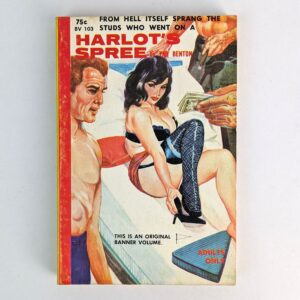
Harlot’s Spree
AU$50 Read MoreAdd to cartTad Benton
: Banner Volumes, 1964.From hell itself sprang the studs who went on a Harlot’s Spree. 20th century American pulp smut fiction. BV 103.
-
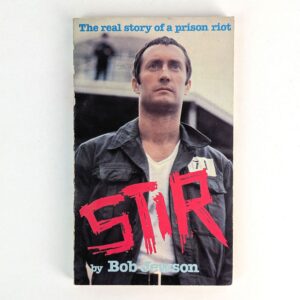
Stir
AU$50 Read MoreAdd to cartBob Jewson
Melbourne: Unicorn Books, 1980.Novelisation of the 1980 prison film based on the 1974 prison riot at Bathurst Correctional Complex and the subsequent Royal Commission into New South Wales Prisons.
-

The Darker Passions: Frankenstein
AU$30 Read MoreAdd to cartAmarantha Knight
New York: Masquerade Books, 1998.Erotic horror fiction.
-
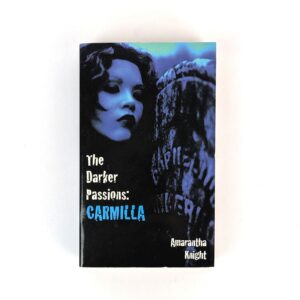
The Darker Passions: Carmilla
AU$30 Read MoreAdd to cartAmarantha Knight
New York: Masquerade Books, 1997.Erotic horror fiction.
-
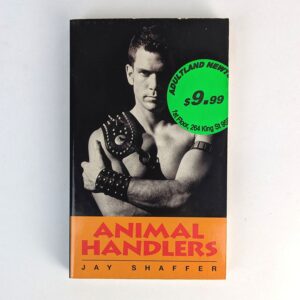
Animal Handlers
AU$40 Read MoreAdd to cartJay Shaffer
New York: Badboy, 1994.Gay pulp short story collection.
-
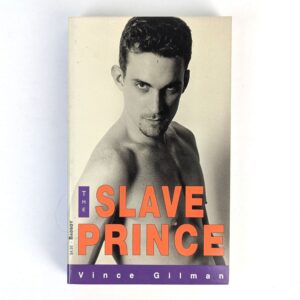
The Slave Prince
AU$40 Read MoreAdd to cartVince Gilman
New York: Badboy, 1994.One of the many gay erotic pulp novels produced in the mid to late 20th century. These short sexually explicit stories, many of which were formulaic and published in easily recognisable series with graphically illustrated covers and titillating titles each targeting a specific sexual niche, demonstrate the breadth of sexual fantasy, occupation, desire, and deviance of the emerging homosexual culture.
-
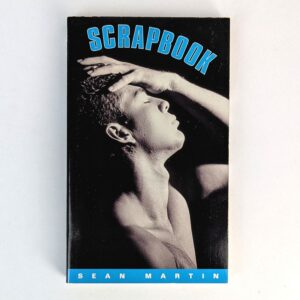
Scrapbook
AU$40 Read MoreAdd to cartSean Martin
New York: Badboy, 1994.Gay pulp short story collection.
-
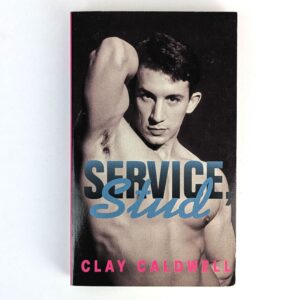
Service, Stud
AU$40 Read MoreAdd to cartClay Caldwell
New York: Badboy, 1995.One of the many gay erotic pulp novels produced in the mid to late 20th century. These short sexually explicit stories, many of which were formulaic and published in easily recognisable series with graphically illustrated covers and titillating titles each targeting a specific sexual niche, demonstrate the breadth of sexual fantasy, occupation, desire, and deviance of the emerging homosexual culture.
-
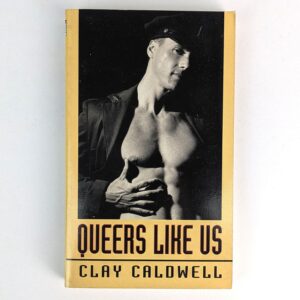
Queers Like Us
AU$40 Read MoreAdd to cartClay Caldwell
New York: Badboy, 1995.One of the many gay erotic pulp novels produced in the mid to late 20th century. These short sexually explicit stories, many of which were formulaic and published in easily recognisable series with graphically illustrated covers and titillating titles each targeting a specific sexual niche, demonstrate the breadth of sexual fantasy, occupation, desire, and deviance of the emerging homosexual culture.
-
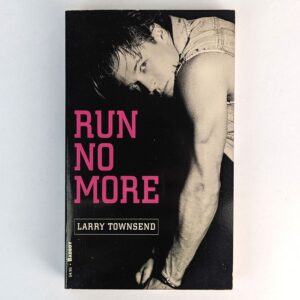
Run No More
AU$40 Read MoreAdd to cartLarry Townsend
New York: Badboy, 1993.One of the many gay erotic pulp novels produced in the mid to late 20th century. These short sexually explicit stories, many of which were formulaic and published in easily recognisable series with graphically illustrated covers and titillating titles each targeting a specific sexual niche, demonstrate the breadth of sexual fantasy, occupation, desire, and deviance of the emerging homosexual culture.
-
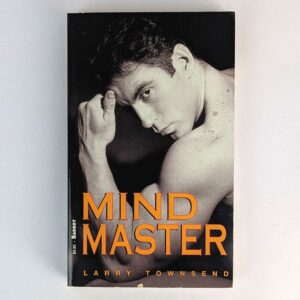
Mind Master
AU$40 Read MoreAdd to cartLarry Townsend
New York: Badboy, 1994.One of the many gay erotic pulp novels produced in the mid to late 20th century. These short sexually explicit stories, many of which were formulaic and published in easily recognisable series with graphically illustrated covers and titillating titles each targeting a specific sexual niche, demonstrate the breadth of sexual fantasy, occupation, desire, and deviance of the emerging homosexual culture.
-
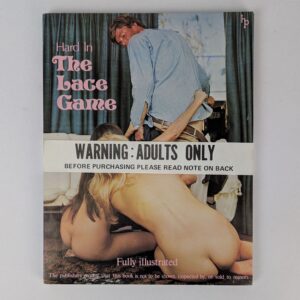
Hard in the Lace Game
AU$50 Read MoreAdd to cartAdina Yurana
Sydney: Howard Productions, 1972.An erotic encounter of a door to door lingerie salesman. Rare Australian erotica.
-
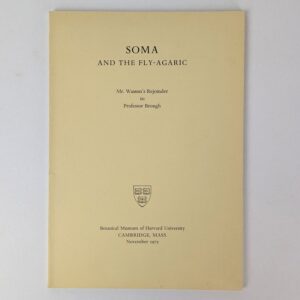
Soma and the Fly-Agaric: Mr. Wasson’s Rejoinder to Professor Brough
AU$600 Read MoreAdd to cartR. Gordon Wasson
Cambridge: Botanical Museum of Harvard University, 1972.Ethnomycological Studies No. 2. Foreword by Richard Evans Schultes. The rare second part of Wasson’s Ethnomycological Studies. The paper is an answer to Prof. John Brough of Cambridge, who contested Wasson’s hypothesis that the original soma plant must have been Amanita muscaria.
-
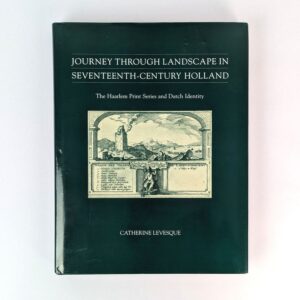
Journey Through Landscape in Seventeenth-Century Holland: The Haarlem Print Series and Dutch Identity
AU$80 Read MoreAdd to cartCatherine Levesque
University Park: The Pennsylvania State University Press, 1994. -
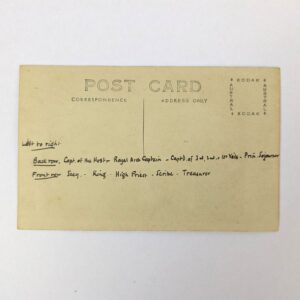
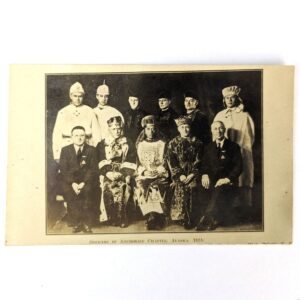
Officers of Anchorage Chapter, Alaska, 1924
AU$40 Read MoreAdd to cart[FREEMASONRY]
Adelaide: Kodak Austral, 1956.Real photo post card of the officers, manuscript note on verso of the positions from left to right.
-
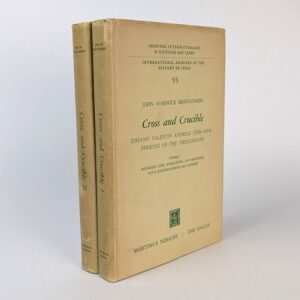
Cross and Crucible: Johann Valentin Andreae (1586-1654) Phoenix of the Theologians
AU$250 Read MoreAdd to cartJohn Warwick Montgomery
The Hague: Martinus Nijhoff, 1973.Volume I: Andreae’s Life, World-View, and Relations with Rosicrucianism and Alchemy; Volume II: The Chymische Hochzeit with Notes and Commentary
-

The Spider and the Green Butterfly: Vodoun Crossroads of Power
AU$150 Read MoreAdd to cartE. A. Koetting; Baron De Prince
: Eternal Ascent Publications, 2009. -
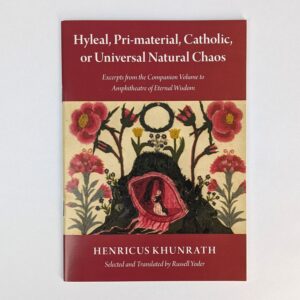
Hyleal, Pri-material, Catholic, or Universal Natural Chaos
AU$150 Read MoreAdd to cartHenricus Khunrath; Russell Yoder; Paul Hardacre
Brisbane and Chiang Mai: Unearthed Arcana, Salamander and Sons, 2013.Excerpts from the Companion Volume to Amphitheatre of Eternal Wisdom. Selected and translated by Russell Yoder, edited by Paul Hardacre. Limited to 300 numbered copies.
-
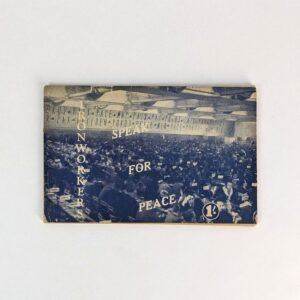
Ironworkers Speak for Peace
AU$40 Read MoreAdd to cartNational Council of the Federated Ironworkers’ Association of Australia
Sydney: National Council of the Federated Ironworkers’ Association of Australia, No date.Report of the rank and file members of the Ironworker’s Union that attended the 2nd World Peace Congress in Warsaw, Poland, November, 1950.
-
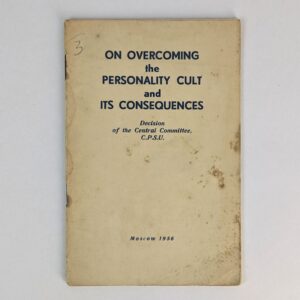
On Overcoming the Personality Cult and Its Consequences: Decision of the Central Committee, C.P.S.U
AU$200 Read MoreAdd to cartCentral Committee, Communist Party of the Soviet Union
Union of Soviet Socialist Republics: Central Committee, Communist Party of the Soviet Union, 1956.The resolution of the Central Committee published in the wake of the anti-Stalin Secret Speech by Soviet leader Nikita Khrushchev at the 20th Congress of the Communist Party of the Soviet Union, 25 February, 1956.
-
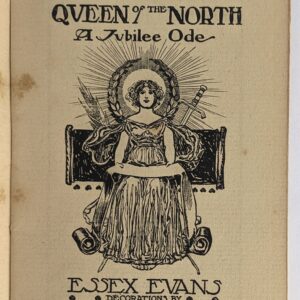
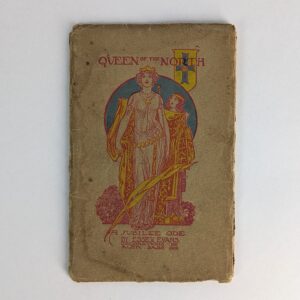
Queen of the North: A Jubilee Ode
AU$100 Read MoreAdd to cart[George] Essex Evans; Alek Sass [Alexander Phillip Sass]
Brisbane: H. J. Diddams & Co., 1909.Queensland poetry by George Essex Evans illustrated by Alexander Phillip Sass in a mythological medieval style with numerous nude female figures. Queen of the North: A Jubilee Ode has previously been misattributed as a posthumous publication, Evans having died in November of 1909, however this has been proven incorrect, and is actually the final published work.
-
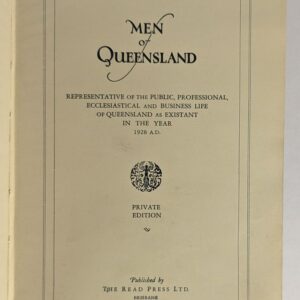
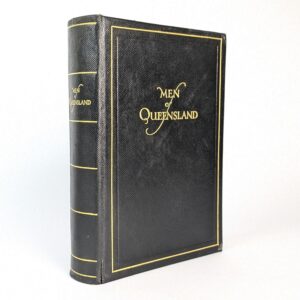
Men of Queensland: Representative of the Public, Professional, Ecclesiastical and Business Life of Queensland as Existant in the Year 1928 A.D.
AU$850 Read MoreAdd to cartWill. H. Millar
Brisbane: The Read Press, 1929.Printed and Published by The Read Press, Engravings by S. A. Best, Photographs by Poulsen Studios, Caricatures by Will. H. Millar. Chiefly caricatures by Will. H. Millar with accompanying biographical text of 211 notable men of early 20th century Queensland. This copy with the preliminary plate of John Oxley looking down over Brisbane printed in colour and with the armorial bookplate of Brian Leask to the front pastedown.
-
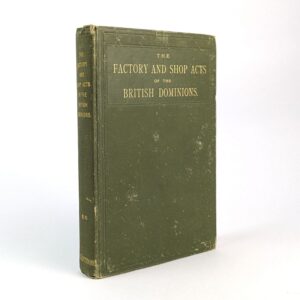
The Factory and Shop Acts of the British Dominions. A Handbook
AU$50 Read MoreAdd to cartViolet R. Markham; H. J. Tennant
London: Eyre & Spottiswoode, [1908].Compiled by Miss Violet R. Markham. Together with a General View of the English Law; and a Preface by Mrs. H. J. Tennant. Issued by the Industrial Sub-Committee of the Victoria League. Covers Australia, New Zealand, Canada, and the Cape of Good Hope.
-
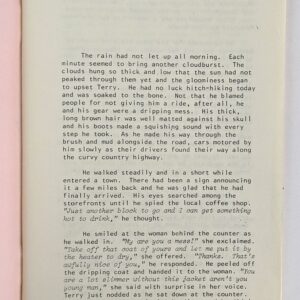
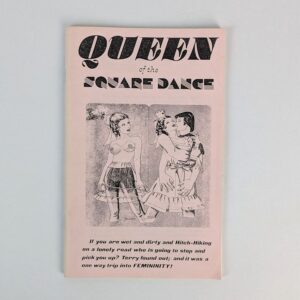
Queen of the Square Dance
AU$50 Read MoreAdd to cartAnonymous
: No publisher, No date.Reprint of an anonymous femdom forced feminisation crossdressing fiction. “If you are wet and dirty and Hitch-Hiking on a lonely road who is going to stop and pickup you up? Terry found out; and it was a one way trip to FEMININITY!” Cover illustration by Erica, dated 1977.
-
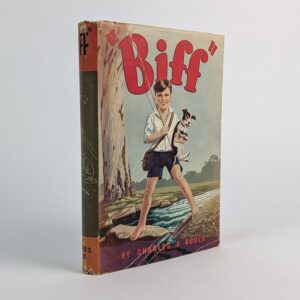
Biff
AU$50 Read MoreAdd to cartCharles S. Gould
Sydney: Jons Productions, [1945].Australian juvenile fiction. Adventure story about a boy from the Queensland bush. MUIR 2904.
-
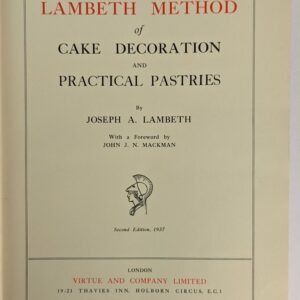
Lambeth Method of Cake Decoration and Practical Pastries
AU$200 Read MoreAdd to cartJoseph A. Lambeth
London: Virtue and Company, 1937. -
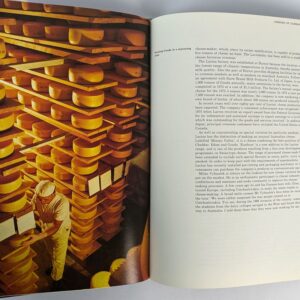
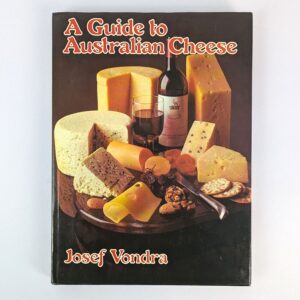
A Guide to Australian Cheese
AU$50 Read MoreAdd to cartJosef Vondra
Melbourne: Thomas Nelson, 1978.The revised edition updated after the author toured Australia visiting major manufacturers and factories.
-
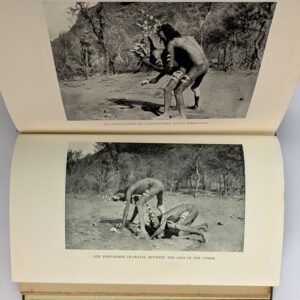
The Riddle of the Sphinx, or Human Origins
AU$150 Read MoreAdd to cartGeza Roheim
London: Leonard and Virginia Woolf at The Hogarth Press, and the Institute of Psycho-Analysis, 1934.Psychoanalytic anthropology by Hungarian Geza Roheim (1891-1953). Roheim and his wife lived on and around the Hermannsburg Lutheran Mission in central Australia for nine months in 1929. The 9 pages of illustrations in this work being photographs from this time showing Aboriginal ceremony.
-
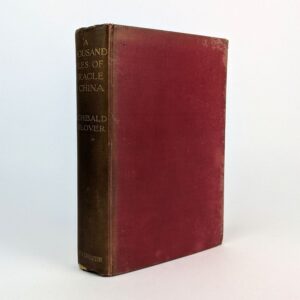
A Thousand Miles of Miracle in China
AU$100 Read MoreAdd to cartArchibald E. Glover
London: Hodder and Stoughton, 1906.A Personal Record of God’s Delivering Power from the Hands of the Imperial Boxes of Shan-si. An account of fleeing China during the Boxer Rebellion by a missionary of the China Inland Mission. The second, or Popular Edition.
-
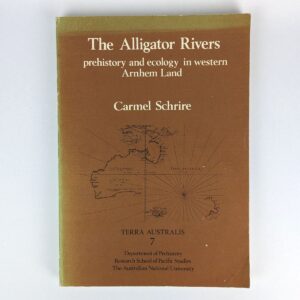
The Alligator Rivers: Prehistory and Ecology in Western Arnhem Land
AU$50 Read MoreAdd to cartCarmel Schrire
Canberra: Department of Prehistory, Research School of Pacific Studies, The Australian National University, 1982. -
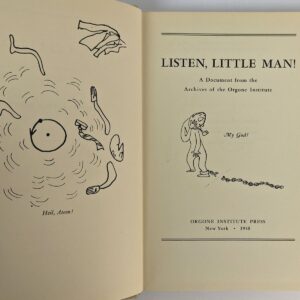
Listen, Little Man! A Document from the Archive of the Orgone Institute
AU$400 Read MoreAdd to cartWilhelm Reich; William Steig
New York: Orgone Institute Press, 1948.First edition in the English language of Reich’s antiauthoritarian classic calling for direct action by the working class. Translated by Theodore P. Wolfe. Illustrated by William Stieg. Wilhelm Reich (1897-1957) was an Austro-Hungraian-American doctor and psychoanalys, and is one of psychiatry’s most radical figures. In the late 1950s many of his books were burned by order of the court in one of the largest cases of modern censorship making early editions of his work scarce.
-
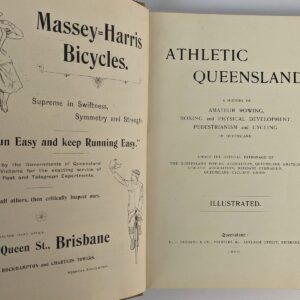
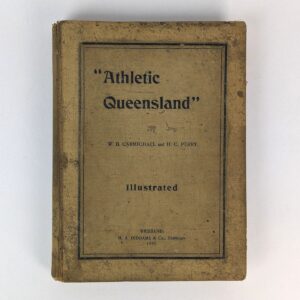
Athletic Queensland: A History of Amateur Rowing, Boxing and Physical Development, Pedestrianism and Cycling, in Queensland
AU$1,200 Read MoreAdd to cartW. B. Carmichael; H. C. Perry
Brisbane: H. J. Diddams & Co., 1900.Under the official patronage of the Queensland Rowing Association, Queensland Amateur Athletic Association, Brisbane Gymnasium, Queensland Cyclists’ Union. 4 works in 1 comprising the most detailed history of 19th century sport in early Queensland recorded by . Not only a detailed guide for physical fitness it is an invaluable record of local history. The four works are: 1. Amateur Rowing: By W. B. Carmichael with contributions by R. H. Roe, C. B. P. Bell, and F. W. de Little: Comprising a history of rowing Brisbane, Maryborough, Rockhampton, &c., crew discipline, how to row (with poses), training, &c.; 2. The Art of Boxing: Hints on Its Acquirement – How to Train – History of Amateur Boxing in Queensland by Harry C. Perry. With which is interwoven a detailed History of the Brisbane Gymnasium, the leading institution of its kind in the colony; and A Special Illustrated Article on Physical Culture, by T. Wilkinson, Together with a concise account of every Athletic Display and Boxing Tournament held under its auspices.; 3. Amateur Pedestrianism by W. B. Carmichael. Also an article on Best Methods of Starting, How to Train, &c. by C. Campbell. A Complete Record of All Intercolonial and Pedestrian Events in the Colony since the Year 1873.; 4. Amateur Cycling by Harry C. Perry. Including an Article on Best Methods of Training and Riding by J. A. Smith, also Recollections of the Pioneers by Geo. Tombuco. A Complete Record of All Principal Events, Both Local and Intercolonial. FERGUSON 7958.
-
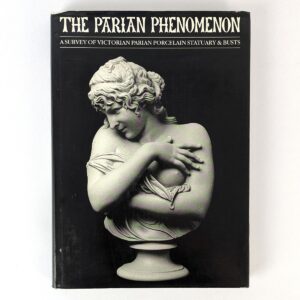
The Parian Phenomenon: A Survey of Victorian Parian Porcelain Statuary & Busts
AU$120 Read MoreAdd to cartPaul Atterbury
Shepton Beauchamp: Richard Dennis, 1989. -
The Growth and Functioning of Leaves
AU$40 Read MoreAdd to cartJ. E. Dale; F. L. Milthorpe
Cambridge: Cambridge University Press, 1983.Proceedings of a Symposium held prior to the Thirteenth International Botanical Congress at the University of Sydney 18-20 August 1981.
-
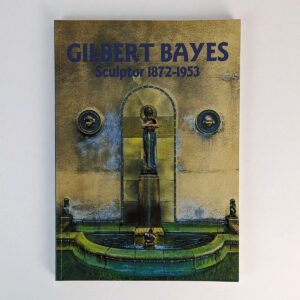
Gilbert Bayes: Sculptor, 1872-1953
AU$50 Read MoreAdd to cartLouise Irvine; Paul Atterbury
Shepton Beauchamp: Richard Dennis, 1998. -
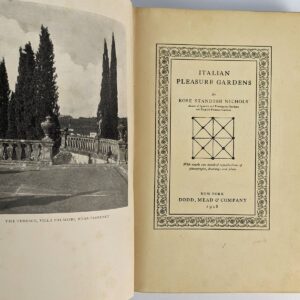
Italian Pleasure Gardens
AU$200 Read MoreAdd to cartRose Standish Nichols
New York: Dodd, Mead & Company, 1928.First printing of the third and final in American landscape architect Rose Standish Nichols’ (1872-1960) studies on the gardens of Europe, preceded by English Pleasure Gardens (1902) and Spanish and Portuguese Gardens (1924). Italian Pleasure Gardens was the first to be illustrated with photographs taken by Nichols on her travels, there being near 200 illustrations throughout.
-
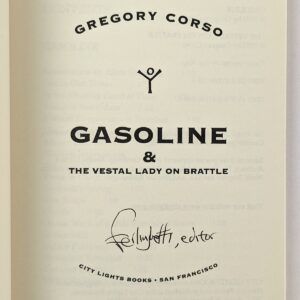
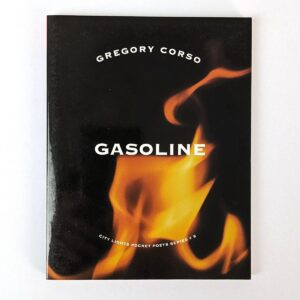
Gasoline & The Vestal Lady on Brattle
AU$100 Read MoreAdd to cartGregory Corso
San Francisco: City Lights Books, [2007].The Pocket Poets Series: Number 8. A circa 2007 later printing. This copy signed by the editor, Lawrence Ferlinghetti.
-
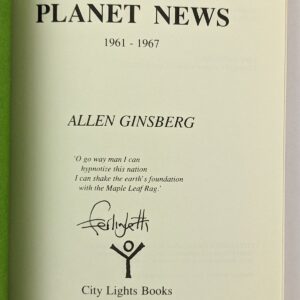
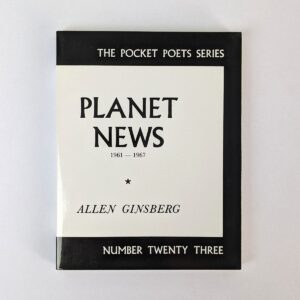
Planet News 1961-1967
AU$100 Read MoreAdd to cartAllen Ginsberg
San Francisco: City Lights Books, 2000.The Pocket Poet Series: Number Twenty Three. This copy signed by the editor, Lawrence Ferlinghetti.
-
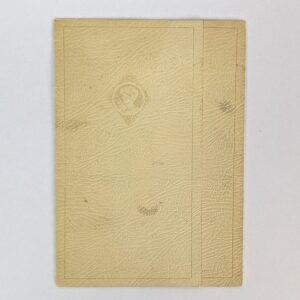
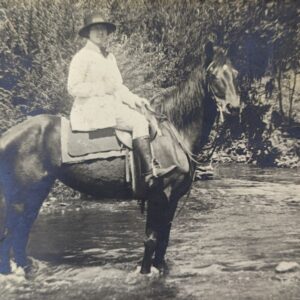
Photographic Portrait of Enid Riding Her Pony
AU$50 Read MoreAdd to cartPhotographer Unknown
[Victoria]: No publisher, No date.Early 1900s photographic portrait or a woman posing atop her horse standing in a creek. Inscribed Christmas greeting by the subject on the verso of the folder to her Dear Auntie and Uncle, the recipients then identifying the pony’s name as possibly Echo.
-
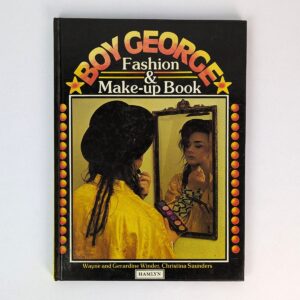
Boy George Fashion & Make-up Book
AU$100 Read MoreAdd to cartWayne Winder; Gerardine Winder; Christina Saunders
London: Hamlyn, 1984.Everything you need to know to achieve that early 1980s Boy George look you always wanted.
-
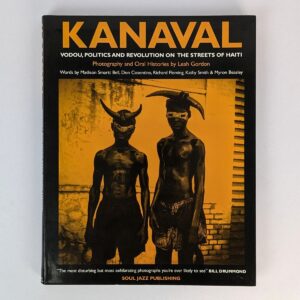
Kanaval: Vodou, Politics and Revolution on the Streets of Haiti
AU$100 Read MoreAdd to cartLeah Gordon
London: Soul Jazz Publishing, 2010.Photography and oral histories by Leah Gordon. Words by Madison Smartt Bell, Don Cosentino, Richard Fleming, Kathy Smith and Myron Beasley.
-
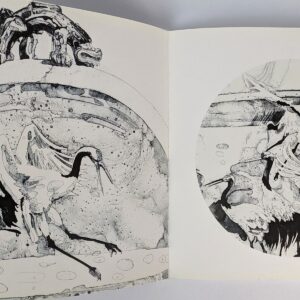
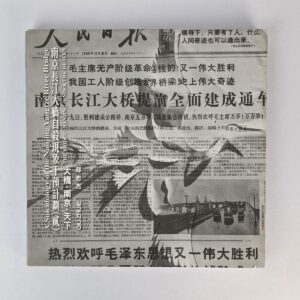
A Suicidology of the Nanjing Yangtze River Bridge: The Bridge – Nanjing – Under the Heaven
AU$80 Read MoreAdd to cartQiu Zhijie
Singapore: Singapore Tyler Print Institute, 2008.A series of artworks based around the Nanjing Yangtze River Bridge, listed as the location of the world’s highest number of suicides by jumping.
-
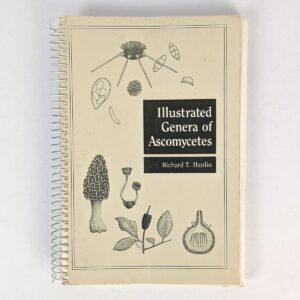
Illustrated Genera of Ascomycetes
AU$50 Read MoreAdd to cartRichard T. Hanlin
St. Paul: The American Phytopathological Society, 1990.A reference tool which allows easy identification of one of the largest groups of fungi to cause diseases of plants. Illustrated by Carol Gubbins Hahn. The first edition, in one volume.
-
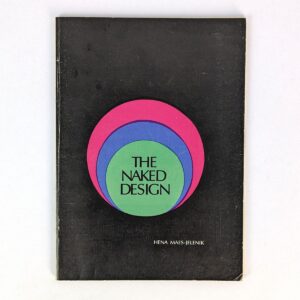
The Naked Design: A Reading of Palace of the Peacock
AU$40 Read MoreAdd to cartHena Maes-Jelenik
Denmark: Dangaroo Press, 1976.A detailed analysis of language and imagery in Wilson Harris’ Palace of the Peacock, authored by Hena Maes-Jelinek. This copy inscribed by the author to Dr. John Stanton Davis Mellick OAM ED (1920-2023), with Mellick’s embossed stamp, and also a manuscript reply letter from Hena to Stan laid in.
-
Studies on Pathological Conditions in the Genitals of the Bull, 1946-1968
AU$100 Read MoreAdd to cartErik Blom; N. O. Christensen
Uppsala and Copenhagen: Various Publishers, 1947-1968.Specially bound collection of papers by Erik Blom and N. O. Christensen, being: 1. Studies on Pathological Conditions in the Testis, Epididymis and Accessory Sexs Glands in the Bull (Uppsala: Almquist & Wiksells Boktryckeri AB, 1947); 2. Congenital Absence of the Epididymis, Ductus Deferens or Glandula Vesicularis (Aplasia Segmentalis Ductus Wolffii) (Copenhagen: Royal Veterinary and Agricultural College, 1951); 3. Examination of the Genitals of Slaughtered Male Calves as a Means of Elucidating the Frequency of Genital Malformation in the Bovine Male (Copenhagen: Communications from The State Veterinary Serum Laboratory, 1956); 4. Cysts and Cyst-like Formations (Inter Alia Spermiostasis) in the Genitals of the Bull (Copenhagen: Royal Veterinary and Agricultural College, 1958). With 2 more booklets laid in at rear: 1. Erik Blom and N. O. Christensen: Seminal Vesiculitis in the Bull Caused by Corynebacterium pyogenes (Copenhagen: State Veterinary Laboratory and the Royal Veterinary and Agricultural College, 1965); 2. H. E. Ottosen: The Danish State Veterinary Serum Laboratory: A Review of Past Achievements and Current Activities (Copenhagen: Communications from The State Veterinary Serum Laboratory, 1968). 6 in total.
-
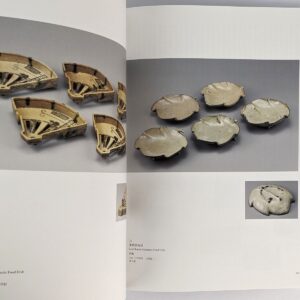
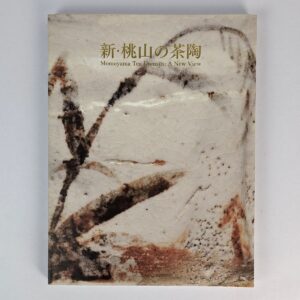
Momoyama Tea Utensils: A New View
AU$100 Read MoreAdd to cartCuratorial Division, Nezu Museum
Tokyo: Nezu Museum, 2018.Catalogue for an exhibition of ceramics from the Momoyama period, and the start of the Edo period.
-
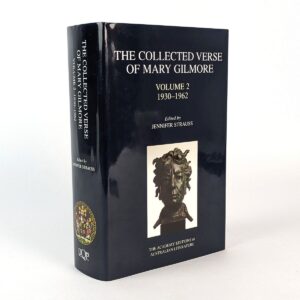
The Collected Verse of Mary Gilmore: Volume 2, 1930-1962
AU$100 Read MoreAdd to cartMary Gilmore
Brisbane: University of Queensland Press, 2007.Edited by Jennifer Strauss. From the Academy Editions of Australian Literature Series, foreword by general editor Paul Eggert.
-
The Honey Flora of South-Eastern Queensland
AU$100 Read MoreAdd to cartS. T. Blake; C. Roff
Brisbane: Department of Agriculture and Stock, Queensland, 1958. -
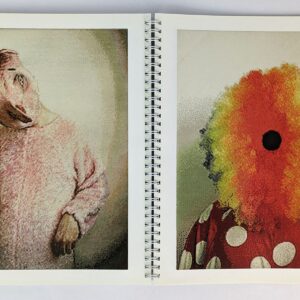
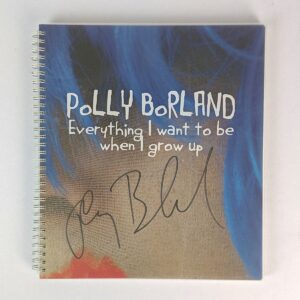
Everything I want to be when I grow up
AU$200 Read MoreAdd to cartPolly Borland
Brisbane: University of Queensland Art Museum, 2012.Celebrated Australian photographer, Polly Borland is famous for her experimental, stylised, and occasionally unsettling portrait images. This exhibition catalogue is from her survey show at UQ Art Museum (University of Queensland), the first to bring together the various diverse threads of her practice. Curated by Alison Kubler, it includes portraits of famous faces such as Cate Blanchett, Nick Cave and Her Majesty Queen Elizabeth II, and the series Australians, The Babies, Bunny and Smudge, and the most recent series, Pupa. “Borland, who draws inspiration from Diane Arbus, carefully directs the costumes, makeup, and poses of her models, creating scenes that are intimate and dystrophic.” This copy signed by Borland.
-
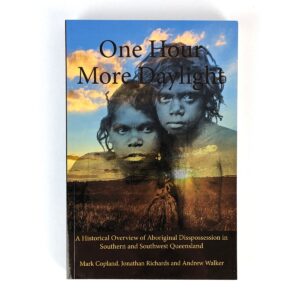
One Hour More Daylight: A Historical Overview of Aboriginal Dispossession in Southern and Southwest Queensland
AU$35 Read MoreAdd to cartMark Copland; Jonathan Richards; Andrew Walker
Toowoomba: The Social Justice Commission, Catholic Diocese of Toowoomba, 2023.Processes of Aboriginal dispossession in Southern and Southwest Queensland. Methods of dispossession. Colonial history. Racism in Queensland/Australia. Aboriginal adaptation to the new economic and social structures. The second edition with nearly 100 more pages.
-
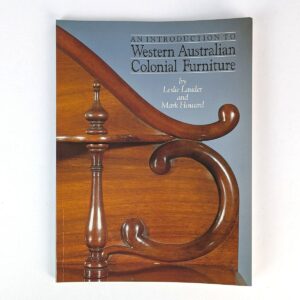
An Introduction to Western Australian Colonial Furniture
AU$65 Read MoreAdd to cartLeslie Lauder; Mark Howard
East Fremantle: Lauder & Howard, 1988.Numbered edition of 2,500 copies, of which this copy is numbered and signed by both authors.